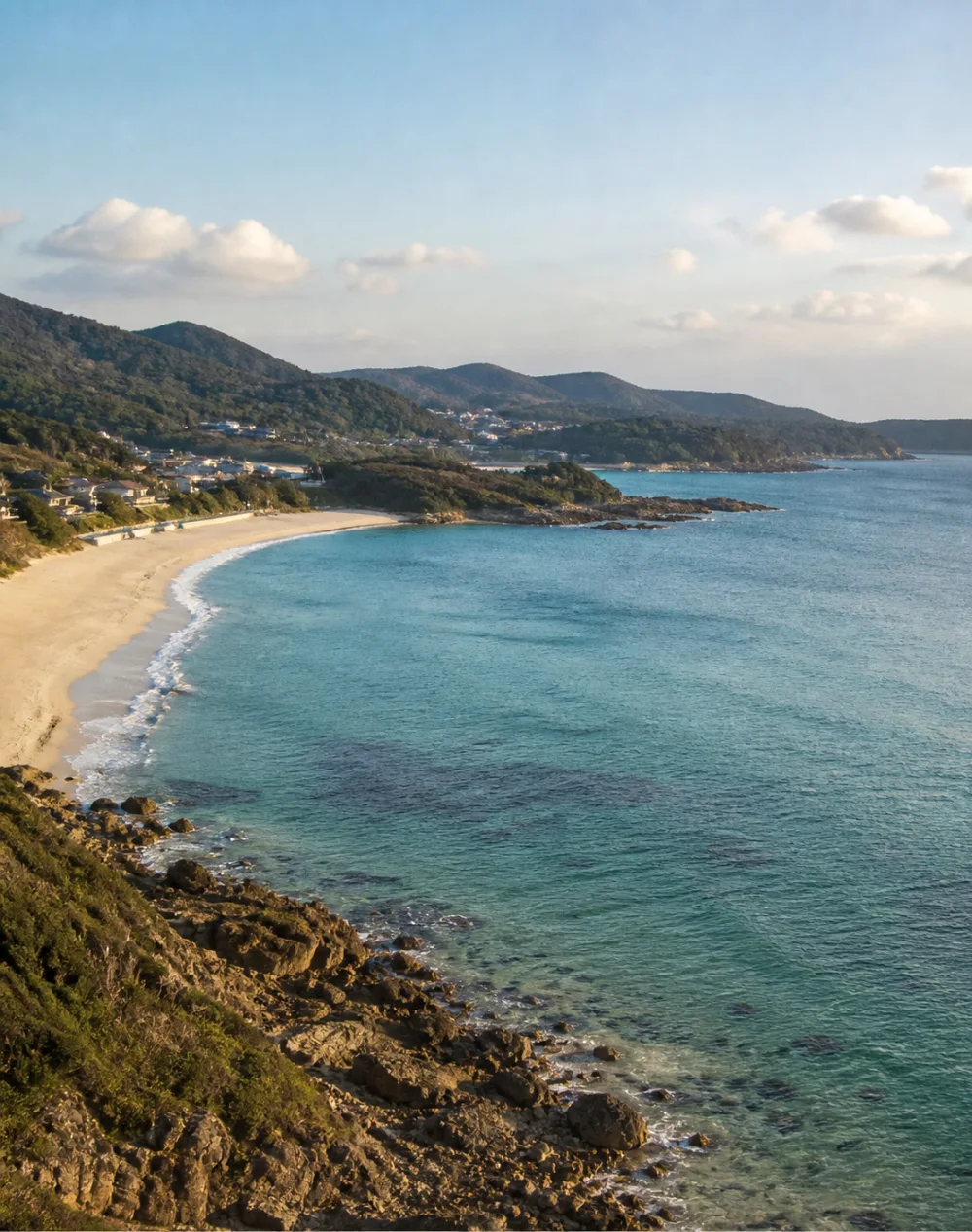
Should this destination stay on your shortlist?
Keep as a top-tier shortlist candidate. It is the “highest probability of working” option rather than the most romantic one.
The verdict
The verdict is positive with one controlling condition: establish a credible right to live in Japan before treating the property as a retirement home. Foreigners can generally acquire Japanese real estate, but a deed does not create residence status, public-healthcare eligibility or domestic borrowing access. Japan has no general retirement visa. The official designated-activities route for long sightseeing permits six months and may be extended to a maximum of one year for eligible applicants, but it requires substantial savings, private medical travel insurance and does not accept dependent children. Fukuoka City also says that people staying under the sightseeing-and-recreation form of designated activities cannot join its National Health Insurance. A buyer planning full-time retirement therefore needs a different, renewable residence basis confirmed before purchase.
Subject to that constraint, Fukuoka / Itoshima suits a buyer who values safe, service-rich daily life more than trophy scarcity or aggressive yield. It is especially credible for someone comfortable using Japanese professional help, willing to separate Fukuoka’s urban convenience from Itoshima’s coastal logistics, and prepared to own a home for personal utility even if short-term rental income disappoints. It is weaker for anyone who expects the purchase to solve immigration, needs high non-resident leverage, refuses car dependence but wants a remote beach setting, or requires a simple absentee rental business.
Proceed in this order: confirm residence and healthcare; decide whether daily life is urban, rail-oriented Itoshima or coastal and car-led; obtain written financing and total-cost assumptions; then investigate the exact title, building, management regime, permitted use and hazards. The combination can work unusually well, but only when the city-and-coast idea is translated into a specific address and a realistic operating plan.
Fukuoka / Itoshima through five destination lenses
Five questions determine whether the city-and-coast proposition will remain useful in ordinary life: where daily services sit, how the last mile works, what the exact property permits, whether demand survives outside peak periods, and who is likely to buy on exit.
Live well between city and coast
Fukuoka makes a credible retirement base because the things that become more important with age are part of the ordinary city rather than a resort overlay. Groceries, restaurants, neighbourhood clinics, larger hospitals, parks and frequent public transport are embedded in a city of roughly 1.67 million people. Food and waterfront access are genuine lifestyle advantages, but the stronger point is repeatability: the city remains useful in rain, winter and shoulder season. Fukuoka City also operates a medical interpreting call centre with round-the-clock support in 20 languages, a meaningful practical aid even though it is not a substitute for insurance, a regular doctor or Japanese-language help with administration.
Itoshima changes the texture. Around Maebaru and the JR Chikuhi Line, a buyer can retain rail access and town services while reaching the coast by car or bus. Farther north and west, the appeal becomes space, sea, cafés, farm shops and a quieter landscape. That appeal comes with more driving, less frequent public transport and greater variation in nearby medical and household services. Itoshima City’s own transport material describes buses and community services designed partly to reduce areas with poor public-transport access. That is useful infrastructure, but it is also a warning not to equate a scenic listing with an easy car-free retirement.
Test the preferred pattern in the least flattering conditions. Spend ordinary weekdays in the hottest and wettest period, make the grocery and hospital journeys, and return after dark. In Fukuoka, check noise, summer heat, building management and the walk to transit. In Itoshima, check road width, parking, drainage, salt exposure, internet, waste collection and whether essential trips remain manageable if one household member cannot drive. The destination scores well because it offers choices; retirement fit depends on choosing the one that remains workable year after year.
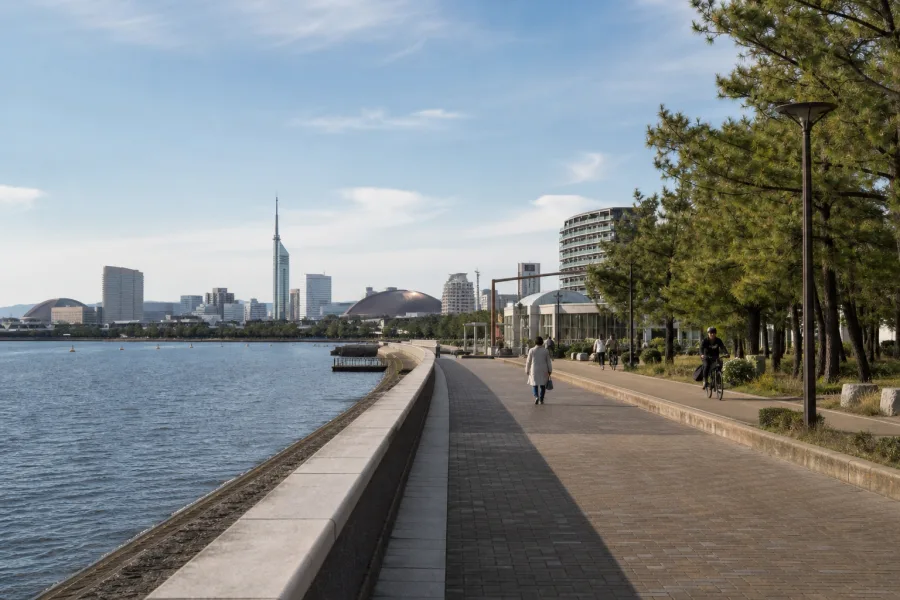
Reach Fukuoka easily—and integrate beyond the airport
Fukuoka Airport is a structural advantage. Its domestic terminal is connected directly to the subway; the airport states that Hakata is about five minutes away and Tenjin about ten. That compresses the tiring final leg of a journey and makes domestic connections practical. The international terminal is not on the subway and requires a free terminal shuttle, an important detail for a buyer comparing brochure-level access with door-to-door travel. From central Fukuoka, rail also connects west toward Meinohama, Maebaru and parts of Itoshima, so the urban side of the proposition can function without a car.
The advantage fades by degrees as the address moves away from the rail spine. Maebaru has a real town centre and station; many celebrated coastal pockets do not. Itoshima City publishes conventional, community and on-demand bus information, and its official access guidance identifies the Chikuhi Line and local bus network. Those services support daily life but should not be treated as metro-frequency substitutes. For a coastal house, calculate the whole journey from the front door to the airport, hospital and supermarket, including a missed connection, bad weather and luggage. A 40-kilometre map radius is not a lifestyle measure.
Foreigner fit is similarly two-sided. Fukuoka has multilingual municipal support, medical interpretation, universities, international business and an airport accustomed to regional travel. Yet purchase documents, tax notices, condominium meetings, contractor coordination and rural neighbour relationships may still operate in Japanese. Non-resident property reporting to the Ministry of Finance is submitted in Japanese, and the practical burden of managing notices continues after closing. Budget for an independent bilingual lawyer, tax adviser and reliable local contact. Integration is strongest when the buyer uses the city’s international accessibility as a bridge into local systems, not as evidence that those systems can be ignored.
Own clearly, then operate locally
Japan’s ownership framework is the cleanest part of the case: nationality is not in itself a general bar to acquiring and registering ordinary real estate. But clean title access is only the opening check. A non-resident acquisition can trigger post-transaction reporting under the Foreign Exchange and Foreign Trade Act; the Ministry of Finance says the report is generally due through the Bank of Japan within 20 days. National and local taxes arise on acquisition, during ownership and on disposal, while non-resident rental or sale income can require Japanese filings, withholding and a tax agent. These are manageable obligations when assigned in writing before closing.
The property-level work is less uniform. For an apartment, read the management bylaws, reserve fund, arrears, major-repair plan, minutes, insurance, pet and renovation rules, and any restriction on lodging use. For a detached home, verify boundaries, legal road access, utilities, extensions, construction records, termite and moisture condition, retaining walls and the cost of insuring and maintaining an often lightly documented asset. In coastal Itoshima, salt, wind, drainage and vacant-period management deserve explicit inspection. A low asking price may reflect land value, age or deferred work rather than a bargain.
Hazard diligence must be address-specific. Fukuoka City’s combined maps cover flood, inland-water, landslide, storm-surge, shaking, tsunami and reservoir risks; Itoshima publishes disaster, reservoir, mountain and coastal hazard material. National rules require water-risk map information in the important-matters explanation, but the official guidance also warns that being outside a mapped inundation zone does not mean zero risk. Overlay the latest municipal maps, visit after heavy rain where possible, confirm evacuation access and obtain an insurance quotation before the offer becomes binding. Regulatory safety here comes from disciplined local verification, not from the national ownership rule alone.
Separate ordinary demand from a rental story
Fukuoka’s financial case should begin with ordinary residential demand. The city’s official statistics show a large and growing population, while the airport, universities, employment base and compact urban form support a broad pool of residents. That does not guarantee rent or appreciation, but it is a more durable foundation than assuming every attractive home can become a high-yield holiday rental. A practical apartment near transit should be compared with long-term rents, vacancy, management fees and eventual owner-occupier resale before any tourist upside is added.
Itoshima requires a sharper split. Maebaru and rail-served neighbourhoods participate more directly in the Fukuoka commuter and local-resident economy. A distinctive coastal house may appeal to second-home buyers and visitors but can face seasonal demand, higher cleaning and management costs, limited nearby operators and a thinner resale pool. The Private Lodging Business Act caps the national minpaku route at 180 nights per year, permits tighter local rules and requires an absent owner to entrust specified duties to a registered administrator. Hotel or inn licensing is a different route. Condominium rules and planning controls can narrow the answer further.
Treat rental income as an operating business, not a property characteristic. Before underwriting it, identify the legal route, confirm the exact premises qualify, obtain written local and building approval, price professional management, and model tax, utilities, cleaning, consumables, platform fees, repairs and empty periods. Then compare the result with a long-term tenancy and with no rent at all. Capital upside should likewise be framed as a scenario, not a promise: Fukuoka’s population and infrastructure are supportive; Itoshima’s scarcity and lifestyle recognition may help selected assets; neither rescues an overpaid, poorly accessed or non-compliant property.
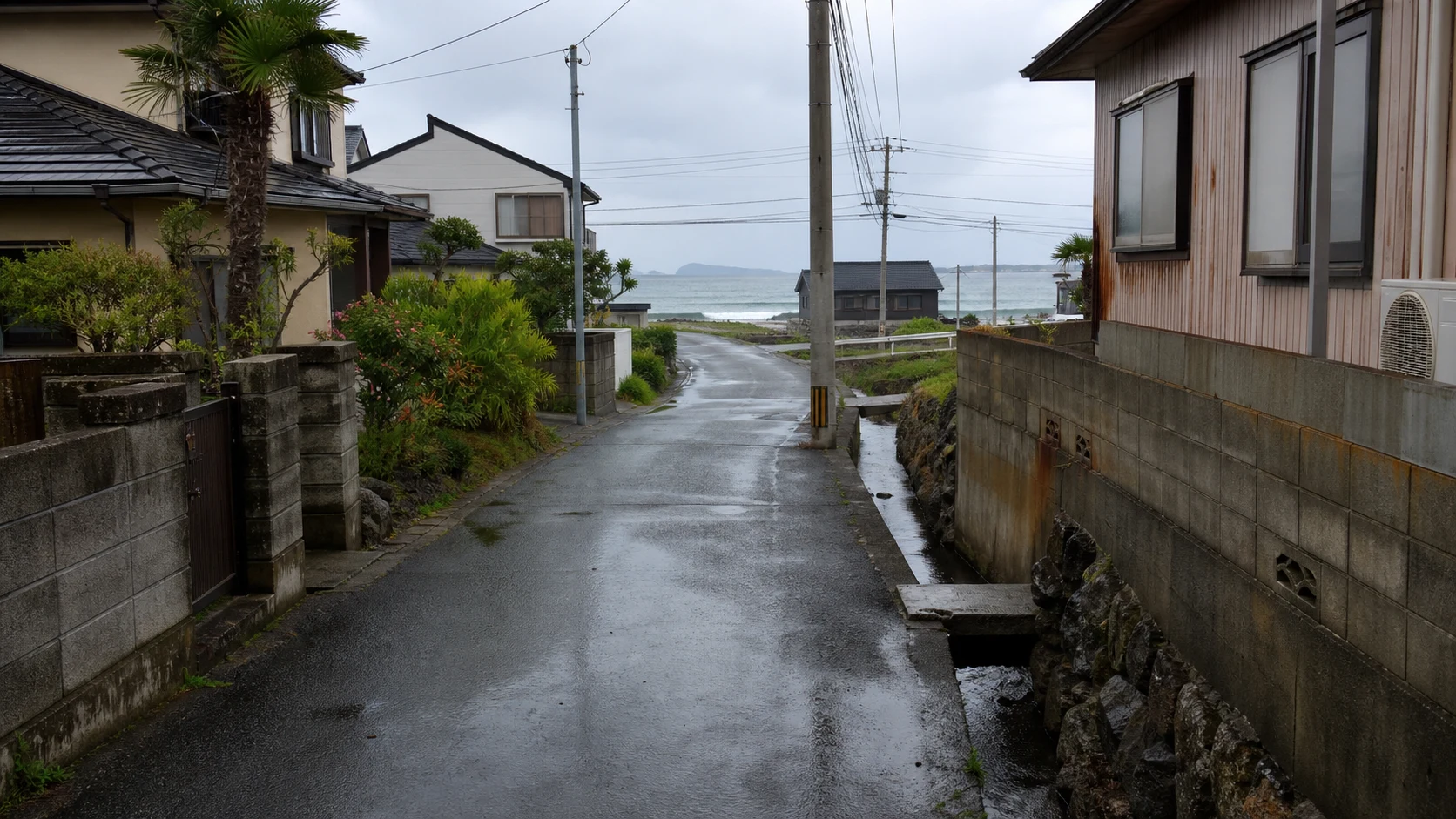
Enter with discipline and preserve the exit
Fukuoka / Itoshima offers several entry points, but they serve different buyer pools. A rail-accessible apartment can provide lower-cost access to services but may carry weak reserves or a dated building. A newer house around Maebaru can offer practical space yet needs location and resale testing. A renovated or newly built coastal home can command a substantial lifestyle premium while reaching fewer year-round buyers. Compare the exact candidate with completed transactions in the Ministry of Land’s Real Estate Information Library and commission a property-specific assessment.
Value entry is created by matching price to the buyer pool that will exist on exit. Central Fukuoka and established station areas generally offer more potential resident demand, but entry prices and competition can be higher. Meinohama and the western corridor may balance access and space. Maebaru is easier to explain to a year-round household than an isolated coast road. A singular sea-view house may be emotionally liquid and financially illiquid: the eventual buyer must share the taste, budget, maintenance tolerance and transport assumptions. Do not pay a city-level price for a property with a narrow rural exit.
Model five-year cash outlay rather than purchase price alone. Include brokerage and legal support, registration and acquisition taxes, financing costs, insurance, management, condominium contributions, repairs, equipment replacement, currency movements and sale costs. For a non-resident, add local representation and tax administration. Before exchange, ask two agents who did not source the property how they would resell it, to whom and at what evidence-based range. The best Fukuoka / Itoshima purchase is not necessarily the cheapest or most scenic; it is the asset whose daily utility, carrying cost and future buyer pool remain aligned.
The Atlas assessment
Here’s how Fukuoka / Itoshima scores on the ten factors that matter most when choosing a long-term home abroad.
| Dimension | Score | Weight | Atlas read |
|---|---|---|---|
| Lifestyle magnetism | 4.3/5 | 10% | Fukuoka combines food, waterfront and year-round city life; Itoshima adds beaches and space, with a more car-dependent rhythm. |
| Global access | 4.8/5 | 10% | Fukuoka Airport reaches Hakata in about five minutes by subway, while coastal Itoshima adds meaningful last-mile time and transport risk. |
| Ownership clarity | 5.0/5 | 12% | Fukuoka and Itoshima follow Japan’s generally open foreign-ownership framework, but non-resident reporting, tax administration and Japanese-language professional support remain necessary. |
| Regulatory safety | 3.0/5 | 8% | Fukuoka and Itoshima require address-level hazard review; short-stay use also faces the 180-night national cap, local rules and building restrictions. |
| Rental profit | 3.8/5 | 13% | Fukuoka has broad long-term residential demand; Itoshima coastal rentals face greater seasonality, management cost, operator dependence and a thinner evidence base. |
| Capital upside | 4.0/5 | 9% | Fukuoka’s population and infrastructure support the case, while Itoshima appreciation is more asset-selective and should not be treated as guaranteed. |
| Retirement fit | 4.6/5 | 11% | Fukuoka offers hospitals, transit and daily services, but legal residence must precede public-healthcare access; remote Itoshima increases driving dependence. |
| Exit liquidity | 4.1/5 | 9% | Fukuoka’s urban and rail-served homes reach a broader buyer pool; singular or isolated Itoshima coastal houses can take longer to resell. |
| Foreigner fit | 4.6/5 | 7% | Fukuoka provides multilingual support and strong regional access, but property documents, tax notices and ongoing Itoshima management may still operate in Japanese. |
| Value entry | 4.2/5 | 11% | Fukuoka apartments, Maebaru houses and premium Itoshima coastal homes span very different price points, maintenance burdens and future buyer pools. |
Weighted assessment: 4.3/5. Reviewed 2026-08-22. Read the scoring methodology.
What homes cost
The current examples run from about ¥31.8 million for a rail-accessible western-Fukuoka apartment to ¥180 million for a large coastal holiday house. Access to rail and ordinary services matters more to resale depth than proximity to the sea alone.
Imajukuekimae 2LDK apartment
- Asking price
- 31,800,000 JPY
- Area
- 52.2 m²Portal-stated area
- USD comparison
- $197,142$3,777/m²
- Buyer relevance
- Practical daily-life apartment observation in western Fukuoka, nine minutes on foot from Imashuku Station; asking price only.
Local comparison — why it matters: 121,700–132,400 JPY/m². Four normal land comparables in the 2026 MLIT appraisal; the same report places a typical new-build house at about 35–45 million JPY. MLIT 2026 appraisal
Shima Keya 5LDK new house
- Asking price
- 34,900,000 JPY
- Area
- 85.7 m²Portal-stated area
- USD comparison
- $216,360$2,525/m²
- Buyer relevance
- Coastal lifestyle house observation in Keya with a long walk to rail; asking price only and completion was scheduled for August 2026.
Local comparison — why it matters: 82,900–108,500 JPY/m². Four normal land comparables used in the 2025 MLIT appraisal, with the standard residential site assessed at 96,000 JPY/m². MLIT 2025 appraisal
Shima Nogita 2SLDK holiday house
- Asking price
- 180,000,000 JPY
- Area
- 291.3 m²Portal-stated area
- USD comparison
- $1,115,899$3,831/m²
- Buyer relevance
- High-end coastal holiday-house observation, 30 minutes by car from Chikuzen-Maebaru Station; asking price only.
Local comparison — why it matters: 7,720–41,400 JPY/m². Selected 2025 residential land benchmarks show how sharply value changes with rail access, settlement and coastal position. Fukuoka Prefecture 2025 land survey
Current asking evidence, not completed-sale valuations. Confirm availability, title, legal use, area, condition, fees and negotiability for the exact property.
Acquisition Costs
| Property price | $262,000 |
|---|---|
| Property price evidence | aligned benchmark |
| Acquisition costs | $9,737 ($9,427–$10,047); known-base/incomplete |
| Effective rate | 3.7%; known-base/incomplete |
| All-in acquisition capital | $271,737 ($271,427–$272,047); known-base/incomplete |
| Purchase route | Available: Direct individual freehold or condominium ownership |
| Acquisition benchmark | Calculable |
| Acquisition evidence | medium |
Known-base/incomplete; 2 unquantified conditional items remain outside comparable totals.
Base cost breakdown
| Component | Category | Amount |
|---|---|---|
| Buyer brokerage commission including consumption tax | brokerage | $9,055 |
| Reduced stamp duty on paper sale contract | tax | $62 |
| Judicial scrivener for title transfer | legal | $620 ($310–$930) |
Conditional items outside the base total
- Registration and license tax (amount unquantified) — Mandatory when ownership is registered, but the amount cannot be calculated until the selected property's fixed-asset assessed land/building values and registrable rights are known. Amount: Not quantified.
- Prefectural real estate acquisition tax (amount unquantified) — Mandatory after acquisition, but the amount cannot be calculated until the selected property's fixed-asset assessed values, land/building split, asset characteristics and any statutory deductions are known. Amount: Not quantified.
Route basis: Japan generally permits a nonresident foreign individual to own land, buildings and condominium title directly. The benchmark assumes a completed resale and no residential relief; property-specific land-use, national-security and reporting checks remain required.
Jurisdiction basis: Fukuoka City in Fukuoka Prefecture is the representative jurisdiction; Itoshima is in the same prefecture. National registration, stamp-duty and brokerage rules and Fukuoka prefectural acquisition tax are modeled. The 100 m2 benchmark price converts to about JPY42.26 million.
Buyer scenario: Nonresident individual · second home · cash · resale · no reliefs
Reviewed: 2026-08-19
Sources
- Baker McKenzie Global Corporate Real Estate Guide - Japan
- Japan Ministry of Land, Infrastructure, Transport and Tourism - tax outline for land acquisition
- Japan National Tax Agency - reduced stamp duty for real-estate transfer contracts
- Japan MLIT - Real Estate Brokerage Act notices
- Karma Legal Japan Judicial Scrivener - buying-cost guide
Where to look
The useful comparison is not Fukuoka versus Itoshima in the abstract. It is a progression from fully urban and transit-led living to lower-density coastal living. Boundaries below are decision aids rather than price zones; confirm the exact address, school district, planning designation, hazard layers and transport timetable.
City to coast
- Central FukuokaUrban and transit-led
- Meinohama corridorConnected western base
- MaebaruTown services with rail access
- Itoshima coastCar-led and seasonal
| Micro-location | Best for | Daily life | Primary diligence |
|---|---|---|---|
| Central Fukuoka | City services | Urban and transit-led | Building and neighbourhood rules |
| Meinohama corridor | City-coast balance | Connected western base | Station access and local hazards |
| Maebaru | Practical Itoshima life | Town services with rail access | Exact walkability and building condition |
| Itoshima coast | Lower-density coastal living | Car-led and seasonal | Hazards, access and maintenance |
Buyer checklist—in decision order
- Establish the residence and healthcare route.
- Confirm financing and the total cash requirement.
- Choose the urban or coastal daily-life pattern.
- Verify title, planning, condition, governance and access.
- Review every site-specific hazard.
- Confirm intended rental use and operating rules.
- Price maintenance, management, tax, insurance and currency exposure.
- Test resale demand before making a binding offer.
For the national residence, tax and ownership framework, read about buying property in Japan and retiring in Japan. To size the plan, use the retirement abroad calculator. Compare directly with Hakone / Izu, Hakuba and Niseko, or open the full Atlas.
Compare this market for FIRE Abroad
References and update policy
Substantive legal, administrative, access, health and hazard claims were reviewed on 21 August 2026 against the official sources below. Rules, municipal maps, transport and listing availability can change. Recheck the current source and obtain Japanese legal, tax, immigration, building and insurance advice for the exact buyer and property before signing. Listing observations are dated asking-price evidence only; they do not verify availability, title, condition, negotiability or completed value.
- Japan retirement property guide
- Ministry of Foreign Affairs: designated activities for long sightseeing and recreation
- Ministry of Finance: non-resident real-property reporting under FEFTA
- National Tax Agency: non-residents buying, renting or selling Japanese real estate
- Ministry of Land: taxes when buying, holding and selling land
- Ministry of Land: water-hazard maps in the important-matters explanation
- Ministry of Land: Real Estate Information Library
- Ministry of Land: 2026 Imashuku appraisal and comparable land evidence
- Ministry of Land: 2025 eastern Itoshima appraisal and comparable land evidence
- Fukuoka Prefecture: 2025 land-price survey
- Japan Tourism Agency: Private Lodging Business Act
- Fukuoka Airport: official access guidance
- Fukuoka City: population and municipal statistics
- Fukuoka City: National Health Insurance eligibility
- Fukuoka City: multilingual medical support
- Fukuoka City: comprehensive hazard maps
- Itoshima City: disaster and coastal hazard maps
- Itoshima City: public transport and bus information
- Itoshima City: current city-planning map