Should this destination stay on your shortlist?
Add as the North American retirement-water benchmark. Strong lifestyle fit, but policy and tax diligence matter.
The verdict
The verdict is conditional. Vancouver Island can be an excellent long-term home for a Canadian citizen, permanent resident or other buyer who clearly falls within a statutory exception. It is not presently an open residential market for most non-Canadians. The federal Prohibition on the Purchase of Residential Property by Non-Canadians Act has been extended through 1 January 2027. It generally catches detached houses, attached homes and condominium units in a census metropolitan area or census agglomeration, while property outside those Statistics Canada geographies is excluded from the regulation’s definition. The line is technical: a postal address, tourism label or agent’s description does not establish eligibility. Obtain a written Canadian legal opinion on the buyer, beneficial owners, property type and exact census geography before making an offer or paying a deposit.
Eligibility does not make the transaction inexpensive. In the Capital Regional District, a foreign national or foreign corporation can face B.C.’s 20% additional property transfer tax on top of the ordinary graduated property transfer tax, unless an exemption applies. A foreign owner may also enter the federal Underused Housing Tax regime, an annual 1% tax with its own filing and exemption tests, and B.C.’s speculation and vacancy tax can apply at a 3% foreign-owner rate for the 2026 tax year. These regimes have different definitions and declarations. They must be checked separately rather than collapsed into a single ‘foreign-buyer tax’ estimate.
For an eligible buyer who accepts those costs, the strongest pattern is a year-round base chosen for ordinary life, not a seasonal income story. Victoria Core offers the deepest hospitals, culture, transit and resale pool. Sidney and the Saanich Peninsula trade some urban depth for airport, ferry and gentler small-town living. Sooke offers space and coast at a longer driving distance, while Nanaimo, Parksville and Qualicum Beach broaden the island search beyond the Victoria metropolitan market. Establish residence and healthcare separately, test access in winter, and treat short-term rental, hazard and resale diligence as address-level work.
Vancouver Island / Victoria through five destination lenses
Five paired lenses turn the island idea into a buyer sequence: qualify legally, choose a daily-life geography, cost every tax and transport dependency, and preserve a credible exit.
Choose a place that still works on an ordinary Tuesday
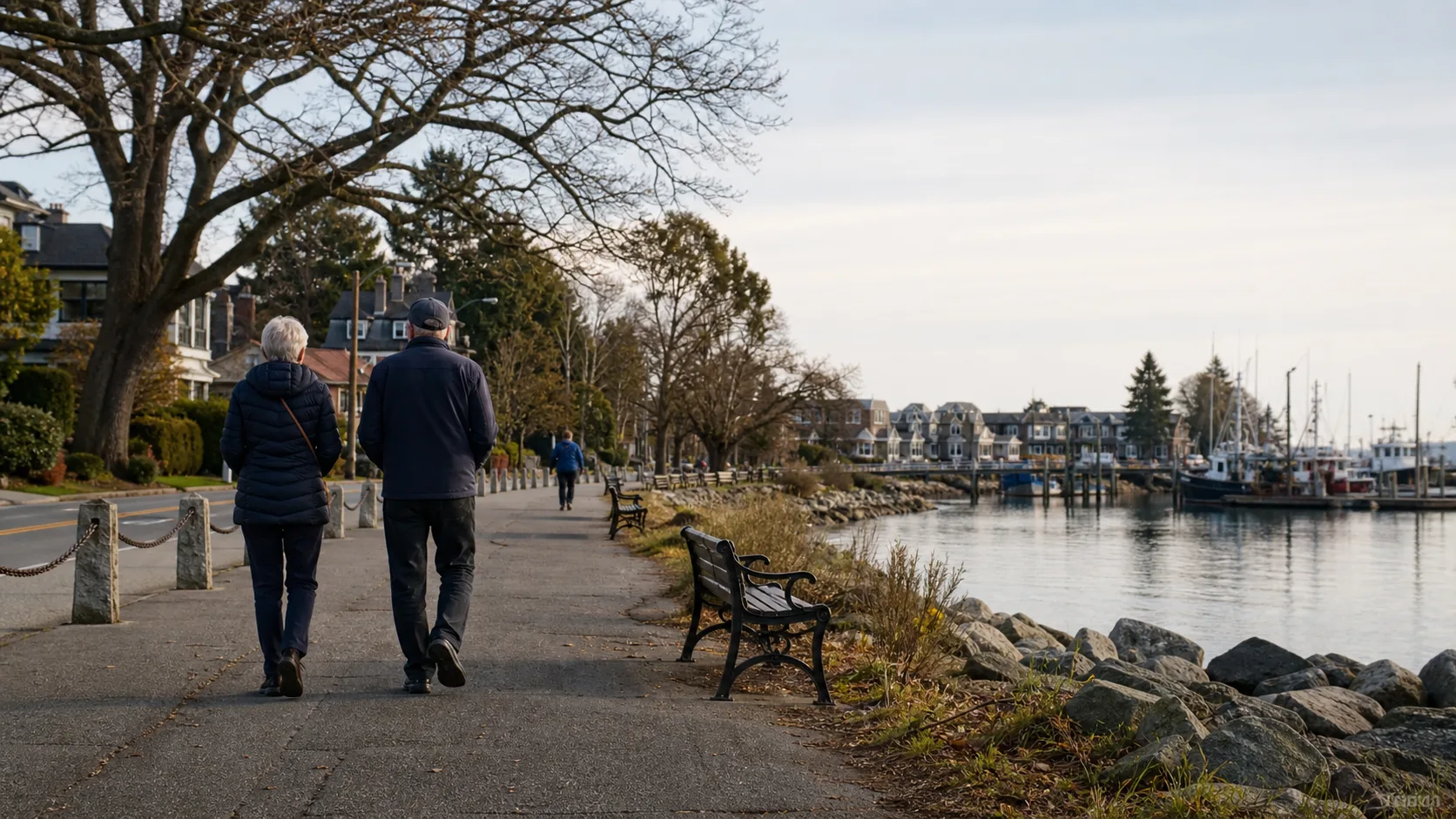
Victoria Core is the most complete retirement proposition on Vancouver Island. Downtown, James Bay, Fairfield, Oak Bay and adjacent neighbourhoods place groceries, culture, waterfront walks, specialists and public transport within a normal urban routine. Royal Jubilee Hospital and Victoria General Hospital give the capital region medical depth that a resort market rarely matches. The city is attractive without being dependent on a short summer season, and its relatively mild coastal winters support walking through much of the year. The trade-offs are high housing costs, wet and dark winter stretches, older strata buildings and a market where a pretty harbour view can obscure noise, wind, reserve-fund or accessibility problems.
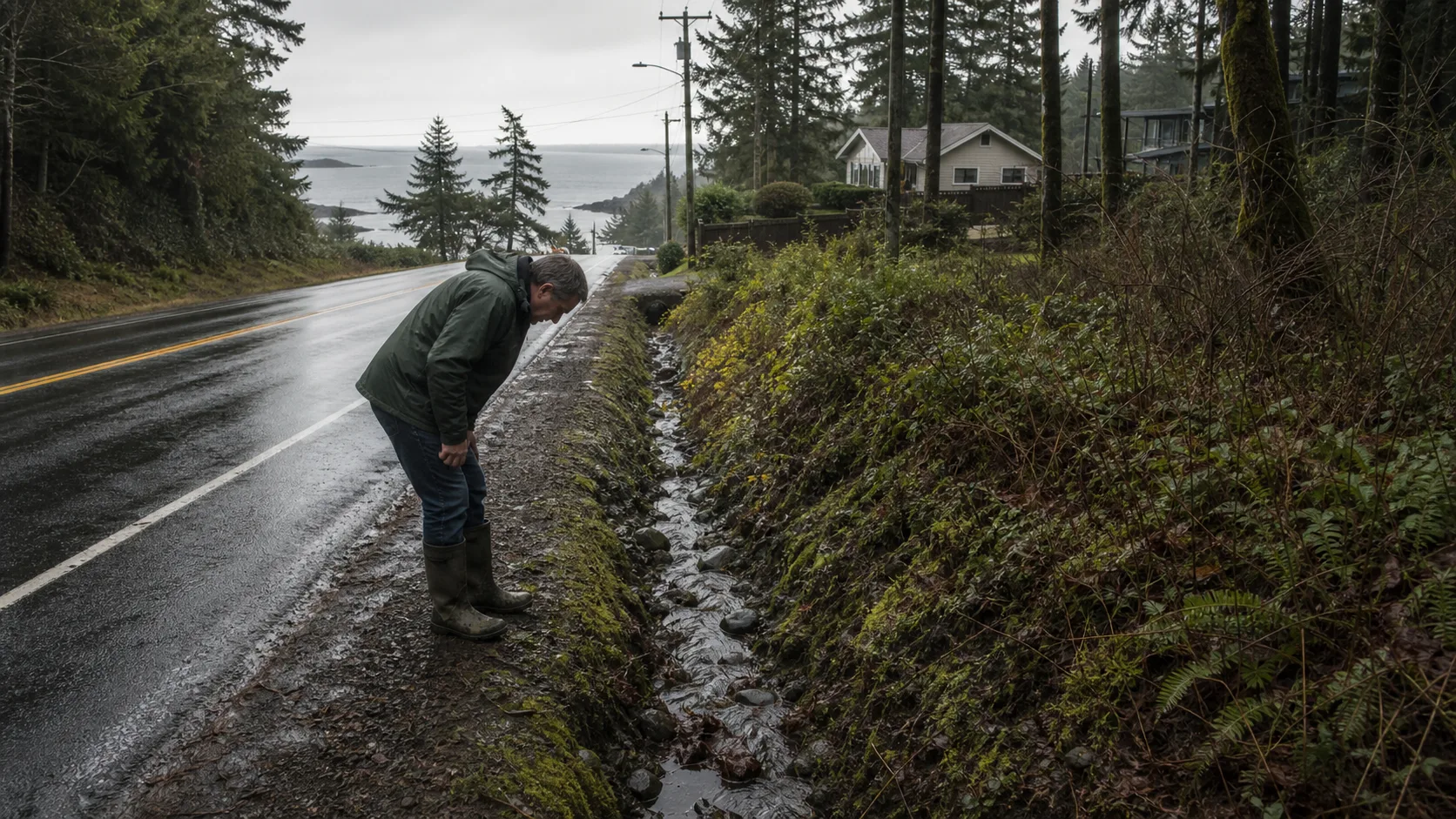
Sidney and the Saanich Peninsula offer a different version of ease. Sidney has a compact centre, level streets, shops, waterfront and proximity to Victoria International Airport and the Swartz Bay ferry terminal. It can suit a buyer who values calm daily life and regional connections over nightlife. Yet the peninsula is not one continuous walkable village. North Saanich and rural pockets often require a car, septic or well diligence and longer trips to major hospitals. Sooke pushes the trade further: dramatic coast, trails and more space, but a constrained road connection toward Victoria and greater dependence on driving, local services and property-level drainage or slope conditions.
Central Island changes both lifestyle and legal geography. Nanaimo is a service city with ferries, an airport, healthcare and a resident economy; Parksville and Qualicum Beach offer established retirement communities and gentler beach life. They are not substitutes for Victoria Core: specialist care, flights, ferry routes, employment and buyer pools differ. Nor should a buyer assume that ‘outside Victoria’ means outside a census agglomeration. Confirm the exact Statistics Canada boundary first. After eligibility, spend two ordinary weeks in winter, complete the grocery, pharmacy and hospital journeys, and test whether the home remains workable if one household member stops driving.
Measure the island from the front door, not the brochure
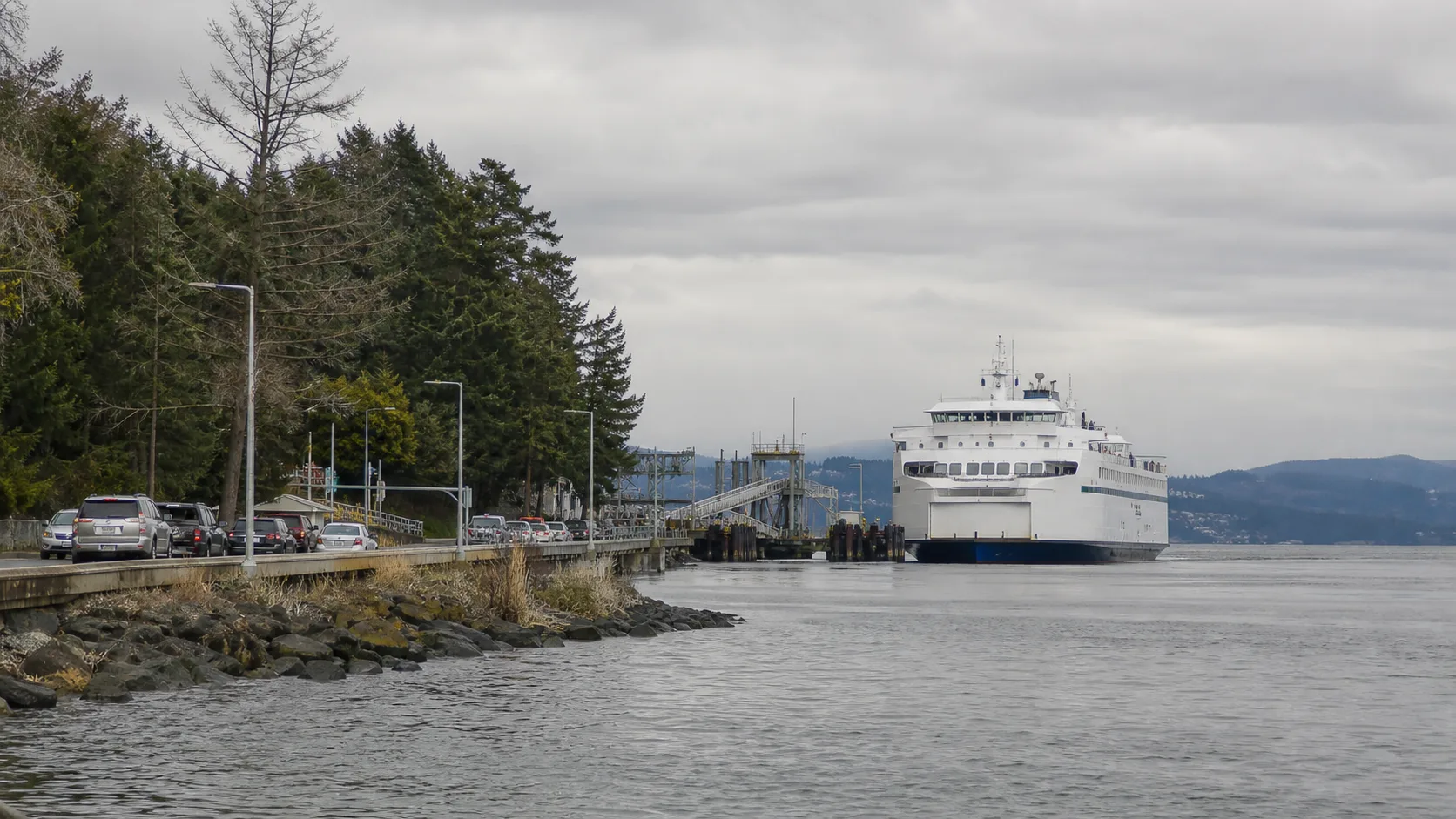
Vancouver Island is connected, but every connection has a last mile. Victoria International Airport sits near Sidney, not downtown Victoria, and the drive can vary with traffic. Swartz Bay provides the principal vehicle-ferry route toward Metro Vancouver, while passenger and vehicle services from Nanaimo create a different access pattern for the central island. Ferries are bookable transport with schedules, fares, weather exposure and peak-period capacity constraints—not a bridge. A household planning frequent international travel should time the complete journey with luggage, a missed sailing and a late arrival, then compare it with living on the mainland.
Within Greater Victoria, buses can support an urban or peninsula routine, but outer suburbs, Sooke and many rural or coastal homes are car-led. Highway 14 is the critical corridor toward Sooke; an incident, storm or construction can change a nominal commute. Farther north, the island highway links communities efficiently by Canadian standards, yet trips between Nanaimo, Parksville and Victoria are long enough to reshape hospital, airport and family access. Ask where the backup route is, how winter wind affects power and trees, and whether charging, fuel, roadside assistance and contractor capacity fit the property.
English-language administration and familiar legal institutions improve foreigner fit, but they do not soften the purchase prohibition. A sophisticated local team should include a lawyer who understands the federal Act and its regulations, a B.C. tax adviser, an independent inspector and, where relevant, a strata specialist. Residence is another file. Canada offers permanent-residence pathways for eligible immigrants, but no general visa that grants retirement residence simply because a home was purchased. The practical sequence is immigration advice, purchase-eligibility advice, tax modelling and only then property search. Ease of communication makes diligence possible; it is not evidence that the answer will be yes.
Prove purchase eligibility, then investigate the exact asset
Canada’s land-registration system can provide clear title, but ownership clarity for a non-Canadian is presently dominated by eligibility. The federal rule covers a non-Canadian’s direct or indirect purchase of prescribed residential property in a census metropolitan area or census agglomeration, subject to defined exceptions. The regulations exclude property outside those geographies and provide exceptions for certain temporary residents, refugees, spouses or common-law partners and other cases. Definitions, control tests and transaction structure matter. Do not rely on a seller, developer or agent to decide them; obtain written advice tied to the actual parties and parcel.
If eligible, calculate tax from the deed outward. B.C.’s ordinary property transfer tax is graduated by fair market value, with an additional residential rate above CAD 3 million. The 20% additional property transfer tax applies to foreign entities and taxable trustees acquiring residential property in specified areas including the Capital Regional District, subject to exemptions and refund rules. The federal Underused Housing Tax and B.C. speculation and vacancy tax are annual regimes with distinct ownership, use, filing and exemption tests. Municipality-level vacancy taxes and normal property tax may add another layer. A home occupied personally can still create filing work even where an exemption ultimately removes tax.
Property diligence then divides into strata and detached-home files. For a strata apartment or townhouse, read the depreciation report, contingency reserve, budgets, insurance, deductibles, minutes, litigation, special levies, rental bylaws, age restrictions and accessibility. For a detached or rural home, verify title charges, survey, permits, additions, septic, well, oil tank, drainage, retaining walls, trees and insurability. Coastal and low-lying property needs flood and tsunami review; the wider island adds earthquake, wildfire, wind and landslide exposure. Use current provincial and local maps, but commission property-specific inspection and insurance quotations because a map category is not a condition report.
Underwrite long-term use before tourist income
The base rental case is ordinary housing demand, not nightly tourism. CMHC’s 2025 Victoria evidence reported a 3.3% purpose-built vacancy rate and an average two-bedroom rent of CAD 2,120; the condominium rental universe was tighter at 0.3% vacancy with an average two-bedroom rent of CAD 2,688. Those are market-level observations, not a forecast for a candidate. Strata bylaws, unit condition, parking, tenant rules, management cost and provincial tenancy law determine the actual result. Model a professional long-term tenancy after property tax, strata fees, insurance, maintenance, vacancy, tax compliance and a reserve for major repairs.
Short-term rental is a constrained operating case. B.C.’s principal-residence requirement applies in many island communities including Victoria, Saanich, Sidney and Sooke and generally limits an operator to the principal residence plus one secondary suite or accessory dwelling unit. Local bylaws, business licences, strata rules and platform registration can be stricter. A second home bought for visitor accommodation may therefore have no lawful nightly-rental route. Before using any tourism revenue, obtain written confirmation for the exact address and operator, then deduct management, cleaning, utilities, consumables, platform fees, tax, insurance and seasonality. Treat zero nightly income as the default until every permission is proved.
Capital upside is plausible only as a property-specific scenario. Victoria has constrained geography, institutions and a broad resident base, while Sidney, Sooke and retirement-oriented central-island communities offer different demand. Yet high entry costs, policy changes, interest rates and a narrower eligible foreign-buyer pool can offset scarcity. VREB’s July 2026 benchmark of CAD 1,311,000 for a Victoria Core single-family home and CAD 548,600 for a Core condominium describe matched product categories; B.C. Assessment’s CAD 786,000 typical Sooke single-family value is an assessment anchor dated July 1, 2025. None prices a candidate or guarantees appreciation.
Pay for a future buyer pool, not only a view
The three asking observations below expose the danger of one island-wide price. A renovated Downtown Victoria strata apartment asks CAD 669,000 for 986 square feet of stated finished area. A new Sidney strata townhouse asks CAD 859,800 for 1,258 square feet. A large Sooke oceanfront strata townhouse asks CAD 1,098,000 for 2,933 square feet. Converted per-square-metre figures differ because the products, land relationship, age, location, services and common obligations differ. They are asking evidence—not valuations, completed transactions or proof that a non-Canadian may purchase them.
Value entry begins with a matched set. Compare a candidate apartment with completed sales in the same building or immediate micro-market, then adjust for floor, exposure, parking, condition, reserve funding and levies. Compare a Sidney townhouse with similar completed new and resale product, warranty and strata burden. Compare a Sooke coastal home with lawful internal area, site, access, foreshore exposure, insurance and maintenance—not with a Victoria Core detached benchmark. Commission an independent valuation where the price or financing warrants it, and model currency movement because the household’s liabilities and future proceeds may be in CAD while wealth is elsewhere.
Exit liquidity depends on who can legally and practically buy next. Victoria Core has the broadest local owner-occupier and rental-investor pool, but an older or weakly funded strata can still be difficult. Sidney’s retirement appeal is durable when the home is accessible and near services. Sooke and remote coast assets can take longer because driving, condition, insurance and taste narrow demand. Federal rules may change after January 1, 2027, but do not underwrite an exit on an assumed policy outcome. Ask two agents who did not source the property for completed evidence, likely buyer profile and realistic sale time; model a slow resale with full costs and no appreciation.
The Atlas assessment
Here’s how Vancouver Island / Victoria scores on the ten factors that matter most when choosing a long-term home abroad.
| Dimension | Score | Weight | Atlas read |
|---|---|---|---|
| Lifestyle magnetism | 4.1/5 | 10% | Victoria Core combines waterfront, culture and year-round services; Sidney, Sooke and Parksville trade urban depth for quieter coastal routines. |
| Global access | 3.6/5 | 10% | Victoria Airport and Swartz Bay support regional travel, while Sooke and central Vancouver Island add driving, ferry and disruption sensitivity. |
| Ownership clarity | 1.8/5 | 12% | Victoria title can be clear, but most non-Canadians face a federal purchase prohibition whose answer depends on buyer, property and census geography. |
| Regulatory safety | 2.2/5 | 8% | Victoria, Sidney and Sooke restrict short stays through the provincial principal-residence rule, while hazards and strata obligations remain address-specific. |
| Rental profit | 3.0/5 | 13% | Victoria has credible long-term demand, but property tax, strata, insurance and tenancy costs constrain yield; second-home nightly rent may be unavailable. |
| Capital upside | 3.2/5 | 9% | Victoria Core scarcity supports selected assets, while Sooke and central-island appreciation depends more heavily on access, condition and the local buyer pool. |
| Retirement fit | 4.5/5 | 11% | Victoria offers the island’s deepest hospitals and services; Sidney is practical, while Sooke, Nanaimo and Parksville require different transport and care planning. |
| Exit liquidity | 3.7/5 | 9% | Victoria Core reaches the broadest resident pool; specialised Sooke waterfront and remote Vancouver Island homes can take longer to resell. |
| Foreigner fit | 2.4/5 | 7% | English-language ease helps administration, but Victoria-area purchase restrictions, stacked taxes and residence rules materially narrow the foreign-buyer case. |
| Value entry | 2.8/5 | 11% | Downtown Victoria, Sidney and Sooke asking evidence spans unlike strata products, so matched completed sales matter more than one island average. |
Weighted assessment: 3.1/5. Reviewed 2026-08-22. Read the scoring methodology.
Representative property evidence
Three direct current observations compare a Downtown Victoria apartment, a Sidney townhouse and a Sooke oceanfront townhouse. They are asking evidence—not valuations. Finished internal area is used consistently; CAD is primary and USD uses the recorded ECB cross-rate.
| Observation | Type | Asking price | USD comparison | Area / basis | USD/m² | Source / captured | Confidence | What it represents |
|---|---|---|---|---|---|---|---|---|
| Downtown Victoria renovated strata apartment | Strata apartment | 669,000 CAD | $486,912 | 91.6 m² 986 sq ft seller-stated finished internal area, converted at 0.09290304 m² per sq ft | $5,315/m² | Realtor.ca 2026-08-22 | Medium | Current Downtown asking observation with a stated CAD 564.11 monthly strata fee; verify availability, title, bylaws, minutes, reserve and buyer eligibility. |
| Sidney new-build strata townhouse | New-build strata townhouse | 859,800 CAD | $625,781 | 116.9 m² 1,258 sq ft seller-stated finished internal area, converted at 0.09290304 m² per sq ft | $5,354/m² | Realtor.ca 2026-08-22 | Medium | Current Sidney asking observation with a stated CAD 140 monthly strata fee; confirm completion, warranties, taxes, bylaws and buyer eligibility. |
| Sooke oceanfront strata townhouse | Oceanfront strata townhouse | 1,098,000 CAD | $799,148 | 272.5 m² 2,933 sq ft seller-stated finished internal area, converted at 0.09290304 m² per sq ft | $2,933/m² | Realtor.ca 2026-08-22 | Medium | Current Sooke oceanfront asking observation; verify strata obligations, insurance, foreshore exposure, access, condition and buyer eligibility. |
Asking-price evidence only. Global Home Atlas has not verified availability, title, legal use, building condition, negotiability, fees or completed transaction value.
Official market anchors
These official VREB and B.C. Assessment figures bound distinct matched products. They are context—not candidate valuations, listing medians or a single island price.
- Victoria Core single-family
- 1,311,000 CAD July 2026 VREB HPI benchmark for a matched single-family category; not an asking price or candidate valuation.
- Victoria Real Estate Board current statistics
- Victoria Core condominium
- 548,600 CAD July 2026 VREB HPI benchmark for a matched condominium category; building condition and strata finances still control a candidate.
- Victoria Real Estate Board current statistics
- Sooke typical single-family
- 786,000 CAD B.C. Assessment 2026 roll typical assessed value as of July 1, 2025; not a completed-sale median or candidate valuation.
- B.C. Assessment Vancouver Island 2026
Acquisition Costs
| Property price | $530,000 |
|---|---|
| Property price evidence | proxy |
| Acquisition costs | $115,247; known-base/incomplete |
| Effective rate | 21.7%; known-base/incomplete |
| All-in acquisition capital | No ordinary all-in total is presented because this purchase route is unavailable. |
| Purchase route | Unavailable: Generic non-Canadian direct residential purchase unavailable through 1 January 2027 |
| Acquisition benchmark | Calculable |
| Acquisition evidence | medium-high |
Known-base/incomplete; 4 unquantified conditional items remain outside comparable totals.
Base cost breakdown
| Component | Category | Amount |
|---|---|---|
| B.C. general property transfer tax if independently eligible | tax | $9,188 |
| B.C. additional property transfer tax for a foreign national | tax | $106,000 |
| LTSA transfer-of-title filing | registration | $59 |
Conditional items outside the base total
- B.C. fair-market-value tax-base uplift — If registration-date fair market value exceeds the unrounded benchmark purchase-price proxy; both general PTT and the 20% additional tax would use the higher statutory value. Amount: Not quantified.
- Legal conveyancing and closing disbursements — Normally used to complete an eligible B.C. purchase; quote varies with title, adjustments and disbursements. Amount: Not quantified.
- Federal non-Canadian purchase-ban exception review — Only if the buyer independently has a statutory person or circumstance exception; the generic baseline has none. Amount: Not quantified.
- GST for a taxable new or substantially renovated home — Only for a taxable new-build or substantially renovated supply, not the completed-resale baseline. Amount: Not quantified.
Route basis: The federal Act prohibits a non-Canadian from directly or indirectly purchasing residential property in a census metropolitan area, subject to specific person and circumstance exceptions. Victoria is a CMA. The baseline generic nonresident foreign individual is not assigned a temporary-resident, spouse, development, nationality or other exception, so ordinary all-in totals are suppressed.
Jurisdiction basis: The City of Victoria in the Capital Regional District, British Columbia, is the representative jurisdiction. Statistics Canada identifies Victoria as a census metropolitan area, so the federal non-Canadian purchase prohibition covers the standardized residential archetype. Victoria is also within a B.C. specified area for the 20% additional property transfer tax. The unrounded CAD963,050.0361143764 benchmark purchase price is used as the proxy for registration-date fair market value; no assessed value is invented.
Buyer scenario: Nonresident individual · second home · cash · resale · no reliefs
Reviewed: 2026-08-19
Sources
- Canada - Prohibition on the Purchase of Residential Property by Non-Canadians Act, section 4
- Department of Finance Canada - Bill C-69 foreign-buyer-ban extension
- Canada - Prohibition on the Purchase of Residential Property by Non-Canadians Regulations
- Statistics Canada - 2021 Census Profile for Victoria CMA
- Province of British Columbia - property transfer tax rates
- Province of British Columbia - additional property transfer tax
- Province of British Columbia - specified areas for additional property transfer tax
- Land Title and Survey Authority of British Columbia - fees
- BC Financial Services Authority - completing a home purchase
Where to look
Use these four operating patterns only after legal geography is confirmed. Victoria Core, the Saanich Peninsula, Sooke and Central Island differ in hospitals, transport, property type, hazards and the future buyer pool.
South to Central Island
- Victoria CoreHospitals, culture and transit
- Sidney / SaanichAirport, ferry and small-town life
- Sooke / West ShoreCoast and car-led access
- NanaimoCentral-island service hub
- Parksville / QualicumRetirement-oriented beach towns
| Micro-location | Best for | Daily life | Primary diligence |
|---|---|---|---|
| Victoria Core | Deepest services, hospitals and walkability | Urban neighbourhoods, transit, waterfront and broad resident demand | Purchase eligibility, strata finances, noise, seismic work and taxes |
| Sidney / Saanich Peninsula | Calm small-town retirement near airport and ferry | Walkable Sidney centre with car-led rural peninsula beyond | Census geography, hospital time, septic or well, strata and coastal risk |
| Sooke / West Shore | More space and dramatic southwest coast | Car-led living with Highway 14 dependence and local services | Road resilience, drainage, slope, tsunami, insurance and resale depth |
| Central Island: Nanaimo / Parksville / Qualicum | Retirement communities with a separate service hub | Nanaimo ferries and healthcare; smaller beach towns farther north | Exact CMA or CA boundary, specialist care, transport, wildfire and exit pool |
Buyer checklist—in decision order
- Obtain written advice on the buyer, beneficial owners, property type and exact CMA or CA geography before offering.
- Confirm residence, tax residence and MSP healthcare eligibility separately from ownership.
- Calculate ordinary property transfer tax, the 20% additional tax, UHT, speculation and vacancy tax, and annual filings separately.
- For strata, read depreciation reports, minutes, insurance, deductibles, levies, bylaws, litigation and accessibility.
- For detached or rural homes, verify permits, survey, septic, well, oil tank, drainage, trees, access and insurability.
- Overlay earthquake, tsunami, flood, wildfire and landslide sources; obtain property-specific inspection and insurance terms.
- Assume zero nightly income until provincial, municipal, strata and operator requirements are confirmed in writing.
- Model winter transport, five-year cash outlay, currency risk and a slow resale to the next eligible buyer.
For the national residence, tax and ownership framework, read about buying property in Canada and retiring in Canada. To size the plan, use the retirement abroad calculator. Compare directly with Whistler and Vancouver, or open the full Atlas.
References and update policy
Legal, tax, residence, healthcare, rental, hazard, transport, market and listing claims were reviewed on 22 August 2026. Recheck immediately after a purchase-ban, tax, short-term rental, transport, hazard, market-data or listing change, and in all cases before a binding offer. Obtain Canadian legal, tax, immigration, inspection, insurance and strata advice for the actual buyer and property.
- CMHC: Prohibition on Purchase of Residential Property by Non-Canadians
- Justice Laws: enacted extension to the fourth anniversary
- Justice Laws: purchase-prohibition regulations section 3
- Canada Revenue Agency: Underused Housing Tax
- B.C.: additional property transfer tax
- B.C.: property transfer tax rates
- B.C.: speculation and vacancy tax rates
- B.C.: short-term rental principal-residence requirement
- IRCC: immigrate to Canada
- B.C.: MSP eligibility
- B.C.: MSP coverage wait period
- Island Health: Royal Jubilee Hospital
- Island Health: specialized intensive-care sites
- PreparedBC: earthquakes and tsunamis
- PreparedBC: landslide preparedness
- B.C. flood hazard map
- BC Wildfire Service: Provincial Strategic Threat Analysis
- B.C.: Highway 14 corridor
- BC Transit: Victoria schedules and route maps
- BC Ferries route map
- BC Ferries fares and bookings
- Victoria International Airport
- CMHC: 2025 rental market reports
- Victoria Real Estate Board current statistics
- B.C. Assessment: Vancouver Island 2026 assessments
- Downtown Victoria asking observation
- Sidney asking observation
- Sooke asking observation
- European Central Bank euro reference rates