Should this destination stay on your shortlist?
Keep as a comparison-only market until the foreign-buyer pathway changes or the buyer clearly qualifies for an exception.
The verdict
The verdict is pause for most non-Canadian buyers. Canada’s prohibition on purchases of residential property by non-Canadians remains in force until 1 January 2027, with defined exceptions. Vancouver is inside the rule’s urban geography, and ordinary houses and condominium units are covered property. The exception analysis depends on the buyer, beneficial ownership, immigration documents, spouse or partner, transaction and intended development—not on the agent’s description. Obtain a written Canadian legal opinion before signing an offer or paying a deposit. A breach can expose the buyer and anyone who knowingly assists to penalties and a court-ordered sale.
The proposition becomes credible for a Canadian citizen, permanent resident or non-Canadian who clearly qualifies for an exception and can absorb the full tax stack. An eligible foreign entity buying residential property in Metro Vancouver generally faces B.C.’s 20% additional property transfer tax on its proportionate share, on top of ordinary property transfer tax. Occupancy can also engage the provincial Speculation and Vacancy Tax and, within the City of Vancouver, the separate Empty Homes Tax. For the 2026 calendar year, B.C. increased the speculation and vacancy tax rate to 3% for foreign owners and untaxed worldwide earners. These are not marginal closing details; they can defeat the purchase thesis.
Proceed in order: prove purchase eligibility and the right to live in Canada; calculate buyer-specific transfer, annual, income and eventual sale tax; choose the weekly service and transport catchment; then inspect title, strata governance, insurance, seismic and flood exposure, permitted tenancy and exit demand. Underwrite personal use or a lawful long-term tenancy. Do not rely on casual short stays: B.C.’s principal-residence floor applies in Vancouver and surrounding large municipalities, with registration and local rules layered above it.
Five questions that decide Vancouver
Five questions separate a durable Vancouver home from a costly legal or tax mistake: whether ordinary life works, how the gateway connects, who may buy and occupy, whether lawful income survives carrying costs, and which future buyer supports the exit.
Choose a neighbourhood that works in rain and without a car
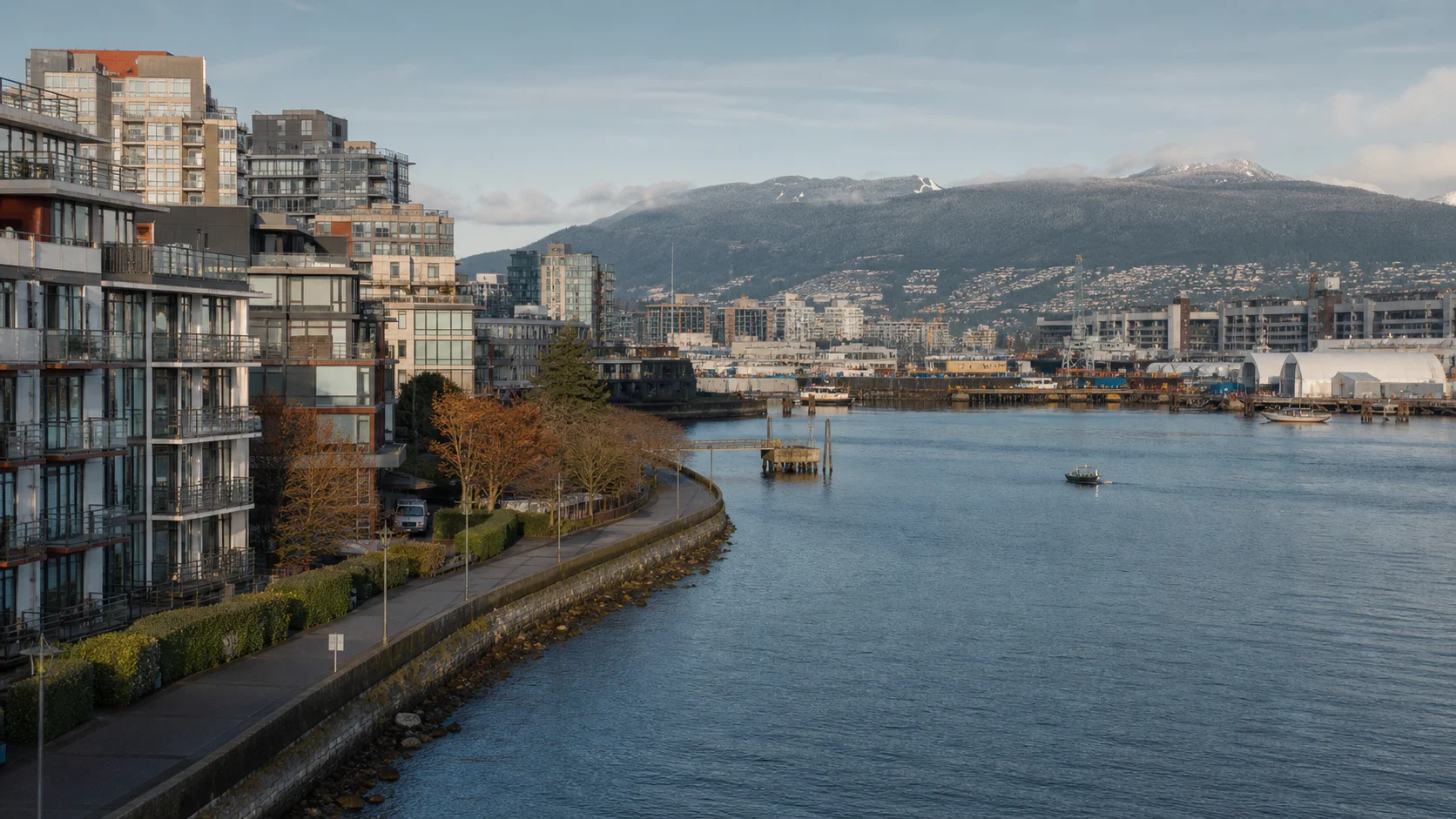
Vancouver’s strongest retirement pattern is compact rather than spectacular. The West End, Yaletown and Fairview can place groceries, seawall walking, rapid transit and daily services inside a short routine. False Creek and the Cambie corridor add access to Vancouver General Hospital and Canada Line stations. Lower Lonsdale offers a North Shore setting with the SeaBus as a dependable downtown connection. Point Grey and West Vancouver deliver space, views and quieter streets, but they shift more journeys to buses or cars and can place a steep walk between the home and ordinary errands.
Healthcare depth is a genuine advantage once the household is eligible and insured. Vancouver General Hospital is a provincial referral centre for trauma, stroke, burns and other specialised care, but ownership does not create immigration status or Medical Services Plan eligibility. A non-resident can face hospital and diagnostic charges, while a newcomer must confirm the current MSP pathway and any waiting period. Establish residence and coverage before purchase, then test the exact route to a regular clinic, pharmacy, emergency department and specialist in winter rain.
Building choice can matter more than postcode. Older concrete and wood-frame strata properties vary in envelope history, elevators, accessibility, plumbing, depreciation reports, reserves and earthquake position. In a detached house, stairs, drainage, roof, heating, renovation permits and garden upkeep affect long-term use. Spend ordinary weekdays in the chosen catchment, make the grocery and hospital trips after dark, and ask whether the home still works if one household member stops driving.
Use the airport and rapid transit as one connected system
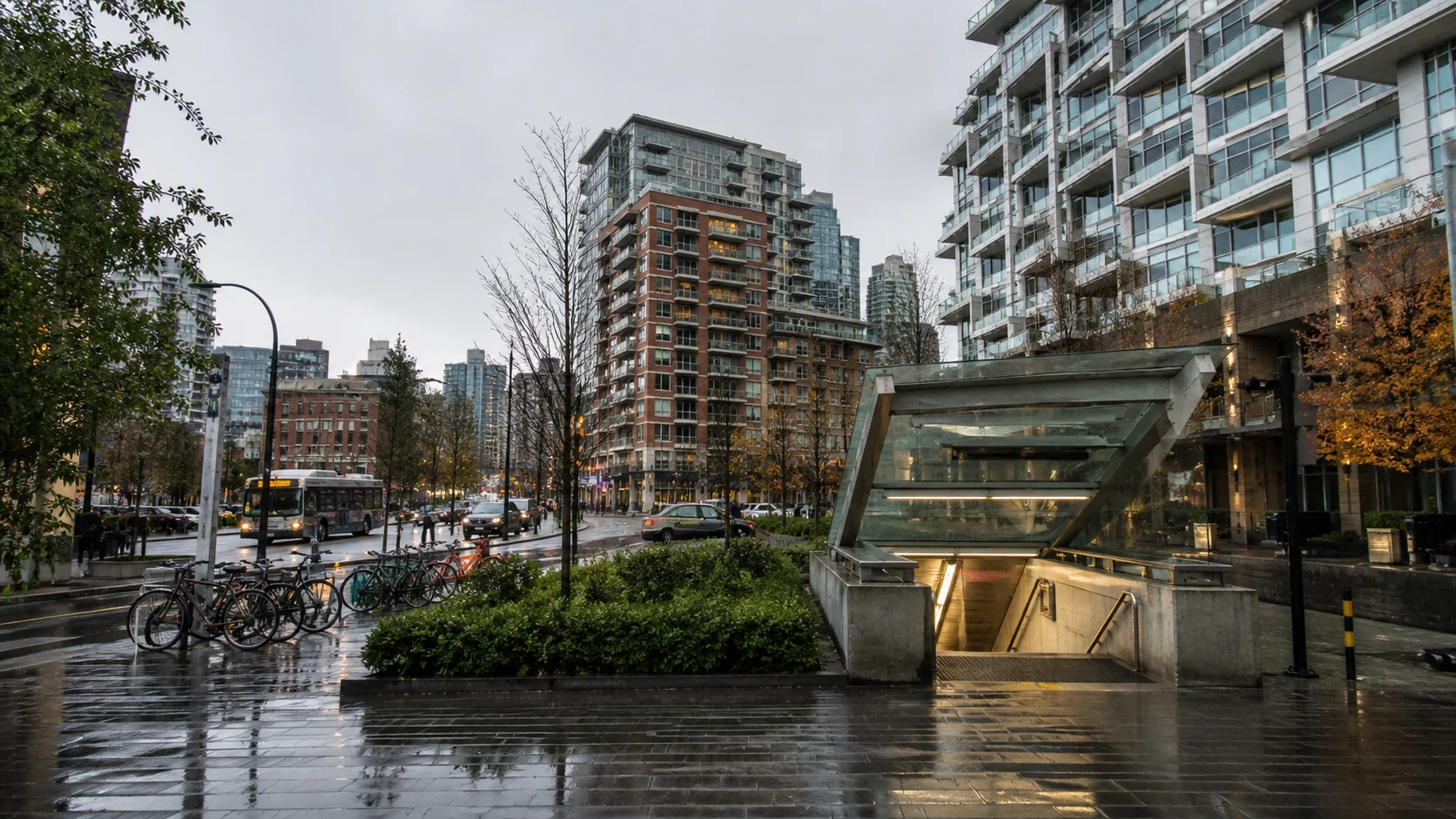
Vancouver International Airport is unusually well integrated with the city. YVR states that the Canada Line reaches downtown Vancouver in under 30 minutes and downtown Richmond in 18 minutes, with the station between the domestic and international terminals. That makes Yaletown, the Cambie corridor and Richmond practical for frequent travel. The benefit becomes less direct in Point Grey, the West End away from a station, and the North Shore, where a bus, SeaBus or road crossing adds another dependency. Time the full trip with luggage and an early departure rather than quoting the rail segment alone.
Foreigner fit is culturally strong and administratively demanding. English-language services, substantial Chinese and South Asian communities, international schools, banks and experienced legal and tax advisers make Vancouver legible to a global household. The hard part is not finding help; it is coordinating federal purchase eligibility, immigration status, B.C. transfer and vacancy taxes, municipal declarations, strata notices and Canadian tax reporting. A buyer who is overseas for part of the year needs an authorised local contact and a calendar for every declaration and tax deadline.
Do not confuse familiarity with permission. A work or study permit may support a statutory exception only if the current conditions are met, and a permitted purchase does not guarantee permanent residence, healthcare, mortgage access or favourable tax status. Collect the buyer’s immigration and ownership documents first, then have Canadian counsel map them to the current federal Act and regulations before the search becomes property-specific.
Clear the legal buyer, then inspect the building and tax stack
The federal purchase prohibition is the controlling ownership rule through the end of 2026. CMHC’s official guidance identifies limited exceptions, including certain purchases with an eligible spouse or common-law partner and purchases for development. It also warns that a violation can be an offence, carry a fine and lead to a court-ordered sale. Because the rule reaches direct and indirect purchases and controlled entities, a company or trust is not a simple workaround. The offer should be conditional on a buyer- and property-specific legal opinion, with beneficial owners disclosed accurately.
Eligibility does not remove B.C.’s cost and reporting layers. Ordinary property transfer tax applies at registration; a foreign entity in Metro Vancouver can owe the additional 20% tax unless a specific exemption or refund route applies. The provincial Speculation and Vacancy Tax and Vancouver’s Empty Homes Tax use different definitions, declarations and exemptions. The federal Underused Housing Tax filing requirement was eliminated for 2025 and later years, but earlier-year obligations can still matter to an existing foreign owner. Obtain one written completion and annual-compliance schedule covering every jurisdiction.
Physical risk is address- and building-specific. Vancouver publishes an earthquake scenario map showing potential concentrations of building damage and a separate designated-floodplain dataset. Neither predicts the fate of a candidate property. Review the strata depreciation report, minutes, reserve plan, insurance deductibles, earthquake coverage, envelope, piping, elevators, balconies and special assessments. For a house, add permits, oil tanks, drainage, foundation, retaining walls, sewer, trees and flood elevation. Confirm the insurer’s response before removing conditions.
Model a lawful long tenancy—not a headline yield
There is no defensible destination-wide net yield. Vancouver has deep tenant demand, but a property-level result depends on purchase price, strata fees, property tax, insurance, repairs, vacancy, management, income tax and the owner’s vacancy-tax position. B.C.’s principal-residence requirement limits short-term rentals in Vancouver and many neighbouring municipalities to the host’s principal residence plus one permitted secondary suite or accessory unit, subject to registration and local bylaws. An absentee holiday-rental case is therefore the wrong base model.
Use a lawful long-term tenancy as the income case and verify the Residential Tenancy Act, municipal use, strata bylaws, lender terms and insurance. In a strata, read rental restrictions, move fees, minimum terms, furnished-use rules and building management capacity. Within the City of Vancouver, a property rented for residential purposes for at least six months in periods of 30 or more consecutive days may satisfy an Empty Homes Tax occupancy route, but the exact declaration and evidence still matter. The provincial tax has its own rules; one exemption does not settle the other.
Capital support comes from constrained geography, employment, universities, immigration and a large domestic buyer pool, but current official data argues against effortless appreciation. Greater Vancouver REALTORS reported May 2026 benchmark prices below year-earlier levels across several segments and active listings well above the ten-year seasonal average. That is useful negotiation context, not a forecast. Pay for an ordinary layout, sound building and useful transit catchment rather than assuming scarcity will erase high taxes or deferred maintenance.
Enter on all-in cost and preserve the Canadian buyer
The three asks illustrate different buyer cases rather than a market average: a CAD 549,900 Yaletown one-bedroom, a CAD 599,000 Lower Lonsdale two-bedroom and a CAD 2.449 million Point Grey detached house. Their areas, ownership form, strata burden and successor pools are not interchangeable. GVR’s May 2026 benchmarks are paired only as property-type and geography context. A benchmark represents a typical property; it is not a completed-sale comparable or valuation of the observation beside it.
For an eligible foreign buyer, entry cost begins before renovation or furnishing. Add ordinary and additional property transfer tax, legal and beneficial-ownership work, mortgage friction, strata contributions, insurance and any immediate building programme. Then model the 2026 provincial vacancy-tax exposure and Vancouver’s separate 3% Empty Homes Tax where applicable. A second home used intermittently can be far more expensive than the headline asking price suggests. Calculate the first five years in Canadian dollars and stress both occupancy and exchange rates.
Exit liquidity is strongest where a conventional Canadian buyer understands the home immediately. A compact Yaletown unit competes on layout, building record, dues and transit. Lower Lonsdale adds SeaBus access but still depends on the exact slope and building. Point Grey reaches a wealthier family and land-value pool, while an unusual luxury view property can be slower and more negotiation-sensitive. Before offering, ask two agents who did not source the listing for likely successor buyers, recent completed sales and a realistic sale timeline after costs.
The Atlas assessment
Vancouver’s overall score captures one metropolitan proposition; the Atlas reads show where federal eligibility, municipal boundaries and the exact building change the answer.
| Dimension | Score | Weight | Atlas read |
|---|---|---|---|
| Lifestyle magnetism | 4.8/5 | 10% | Ocean, mountains, food and compact neighbourhoods are exceptional; rain, price and address-level mobility determine whether the lifestyle remains easy. |
| Global access | 4.7/5 | 10% | YVR and the Canada Line provide unusual gateway depth, while North Shore bridges and outer neighbourhood last miles add variability. |
| Ownership clarity | 1.2/5 | 12% | Most non-Canadians cannot currently buy covered Vancouver homes; defined exceptions require buyer- and property-specific legal clearance. |
| Regulatory safety | 2.0/5 | 8% | Federal eligibility, layered vacancy taxes, strata governance, short-stay rules, seismic risk and flood exposure all require separate checks. |
| Rental profit | 2.2/5 | 13% | Tenant demand is deep, but high entry, tax, strata and management costs prevent a reliable destination-wide net yield. |
| Capital upside | 3.2/5 | 9% | Scarce geography and domestic demand support selected assets; May 2026 benchmarks also show that price direction is neither uniform nor guaranteed. |
| Retirement fit | 4.5/5 | 11% | Healthcare, transit and services are strong for an eligible resident, while coverage, stairs, rain and car dependence can narrow the fit. |
| Exit liquidity | 4.5/5 | 9% | The Canadian buyer pool is broad for conventional homes in useful locations; singular luxury and troubled strata records narrow the exit. |
| Foreigner fit | 1.5/5 | 7% | Multilingual services and advisers are extensive, but purchase eligibility, tax declarations and residence remain administratively demanding. |
| Value entry | 1.2/5 | 11% | Current asks span compact strata units to multi-million-dollar houses; foreign-buyer and vacancy taxes can overwhelm the apparent entry value. |
Weighted assessment: 3.0/5. Reviewed 2026-08-27. Read the scoring methodology.
What homes cost
Three direct asks show a compact Yaletown condominium, a Lower Lonsdale apartment and a Point Grey house. They are dated asking evidence only; availability, eligibility, title, condition, negotiability, fees, insurance, lawful use and completed value remain unverified.
Yaletown 1-bedroom condominium
- Asking price
- 549,900 CAD
- Area
- 48.8 m²Seller-stated 525 ft² finished area converted at 0.09290304 m² per ft²
- USD comparison
- $397,303$8,146/m²
- Buyer relevance
- Yaletown one-bedroom asking observation near the Canada Line and daily services. Seller-stated finished area is 525 ft². Verify purchase eligibility, strata records, insurance, taxes, lawful tenancy and completed comparable sales.
Local comparison — why it matters: CAD 783,300 May 2026 benchmark. GVR’s apartment benchmark is an estimated price for a typical Vancouver West apartment, not a valuation or completed comparable for the CAD 549,900 Yaletown observation. Greater Vancouver REALTORS May 2026 report
Lower Lonsdale 2-bedroom condominium
- Asking price
- 599,000 CAD
- Area
- 76.3 m²Seller-stated 821 ft² finished area converted at 0.09290304 m² per ft²
- USD comparison
- $432,778$5,674/m²
- Buyer relevance
- Lower Lonsdale two-bedroom asking observation with SeaBus access to downtown Vancouver. Seller-stated finished area is 821 ft². Verify purchase eligibility, strata condition, insurance, slope and flood exposure, taxes and completed comparable sales.
Local comparison — why it matters: CAD 783,100 May 2026 benchmark. This apartment benchmark provides property-type and geography context only. It does not adjust for the Lower Lonsdale unit’s size, condition, building, strata fees or legal buyer. Greater Vancouver REALTORS May 2026 report
Point Grey 6-bedroom house
- Asking price
- 2,449,000 CAD
- Area
- 238.7 m²Seller-stated 2,569 ft² finished area converted at 0.09290304 m² per ft²
- USD comparison
- $1,769,402$7,414/m²
- Buyer relevance
- Point Grey detached-house asking observation near UBC and Jericho Beach. Seller-stated finished area is 2,569 ft². Verify purchase eligibility, title, renovation permits, building condition, flood and earthquake exposure, taxes and completed comparable sales.
Local comparison — why it matters: CAD 3,025,000 May 2026 benchmark. The detached benchmark describes a typical Vancouver West property, not the Point Grey house. Land, age, permits, condition and lot characteristics require completed local comparables and inspection. Greater Vancouver REALTORS May 2026 report
Current asking evidence, not completed-sale valuations. Confirm availability, title, legal use, area, condition, fees and negotiability for the exact property.
Acquisition Costs
| Property price | $814,577 |
|---|---|
| Property price evidence | proxy |
| Acquisition costs | Not quantified |
| Effective rate | Not quantified |
| All-in acquisition capital | Not presented |
| Purchase route | Unavailable: Covered residential purchase prohibited for the baseline non-Canadian |
| Acquisition benchmark | Not calculable: A normal all-in acquisition total would imply an available route during the federal prohibition, so totals are suppressed. |
| Acquisition evidence | high |
Known-base/incomplete; 1 unquantified conditional items remain outside comparable totals.
Base cost breakdown
| Component | Category | Amount |
|---|---|---|
| No base components are quantified for this route. | ||
Conditional items outside the base total
- B.C. general property transfer tax — Only if the buyer qualifies for a federal exception and completes a taxable transfer. Amount: $14,879.
- B.C. additional property transfer tax for foreign entities — If an eligible foreign national acquires residential property in Metro Vancouver without a provincial exemption. Amount: $162,915.
- Legal conveyancing, title and registration charges — Only for an eligible purchase; amounts depend on provider, title and filings. Amount: Not quantified.
Route basis: The federal prohibition remains in force until 1 January 2027. Statutory exceptions are buyer- and circumstance-specific and are not assumed.
Jurisdiction basis: Vancouver in the Metro Vancouver Regional District, British Columbia. The federal prohibition covers residential property in census metropolitan areas through 1 January 2027, and the baseline non-Canadian second-home buyer is not assigned an exception.
Buyer scenario: Nonresident individual · second home · cash · resale · no reliefs
Reviewed: 2026-09-04
Sources
Where to look
Choose the weekly transport and service system before choosing the view. Municipal borders also change taxes and rules, so Vancouver, North Vancouver, West Vancouver and Richmond must not be treated as one legal address.
Airport and urban rail spine
- YVR / Richmondinternational gateway and Canada Line
- Cambie / Fairviewhealthcare and rapid-transit corridor
- Yaletown / Downtowncompact services and interchange
Harbour and North Shore
- Waterfront Stationdowntown rail and SeaBus hub
- Lower LonsdaleNorth Shore service base
- West / North Vancouverbus, bridge and more car-led patterns
| Micro-location | Best for | Daily life | Primary diligence |
|---|---|---|---|
| West End / Coal Harbour | Walkable central daily life | Seawall, groceries and downtown services with bus-led access | Strata age, envelope, lifts, dues, Empty Homes Tax and hospital route |
| Yaletown / False Creek | Canada Line and compact urban routine | Rapid transit, seawall, shops and dense apartment living | Layout, noise, strata reserves, insurance, tenancy rules and entry price |
| Fairview / Cambie corridor | Healthcare and transit proximity | VGH, Canada Line and practical neighbourhood services | Construction disruption, building record, accessibility and flood mapping |
| Lower Lonsdale | North Shore life with downtown access | SeaBus, waterfront services and mountain access | Municipal rules, slope, bridge alternative, strata and weather exposure |
| Point Grey / Kitsilano | Family-scale west-side living | Beaches, UBC access and quieter residential streets | Entry tax, renovation permits, older-house systems, transit and exit depth |
Buyer checklist—in decision order
- Obtain a written Canadian legal opinion confirming the buyer, beneficial owners, transaction and property qualify under the federal purchase prohibition.
- Confirm the immigration path, right to occupy Canada, healthcare coverage and financing before treating ownership as a retirement solution.
- Calculate ordinary and additional property transfer tax, annual property tax, provincial vacancy tax, Vancouver Empty Homes Tax and sale-tax obligations.
- Choose the weekly service catchment and time YVR, hospital, groceries and evening return from the exact address in winter conditions.
- Review title, beneficial-ownership filings, municipal permits, strata bylaws, depreciation report, minutes, reserves, insurance, claims and assessments.
- Inspect seismic, flood, drainage, envelope, piping, roof, accessibility and—where relevant—slope, retaining walls and buried oil tanks.
- Confirm the lawful tenancy route with the Province, municipality, strata, lender and insurer; underwrite without short-stay income.
- Model five-year Canadian-dollar carrying and sale cash flow, then test the successor buyer and completed comparable evidence with independent agents.
For the national residence, tax and ownership framework, read about buying property in Canada and retiring in Canada. To size the plan, use the retirement abroad calculator. Compare directly with Whistler and Vancouver Island / Victoria, or open the full Atlas.
References and update policy
Legal, tax, market, transport, healthcare, hazard and listing claims were reviewed on 27 August 2026. Recheck by 27 February 2027 and immediately after the federal purchase prohibition, tax rates, short-term-rental rules, municipal vacancy rules, strata law, hazard maps or listings change. Obtain Canadian immigration and tax advice, B.C. legal advice and property-specific insurance and inspection work. Listings are dated asking observations, not valuations or availability guarantees.
- Canada property guide
- Department of Finance Canada: foreign-purchase prohibition extension
- CMHC: purchase-prohibition questions and exceptions
- B.C.: additional property transfer tax
- B.C.: speculation and vacancy tax rates
- City of Vancouver: Empty Homes Tax
- B.C.: short-term-rental principal-residence requirement
- CRA: Underused Housing Tax update
- Greater Vancouver REALTORS: May 2026 market report
- YVR: Canada Line airport access
- Vancouver Coastal Health: Vancouver General Hospital
- City of Vancouver: earthquake-risk map
- City of Vancouver: designated floodplain data
- Bank of Canada: daily exchange rates
- Redfin: Yaletown asking observation
- Redfin: Lower Lonsdale asking observation
- Redfin: Point Grey asking observation