The quick answer
Among the 33 destinations, Dubai has the lowest modeled requirement at $1,724,014, while Swiss Valais / Vaud Alps has the highest at $5,033,057. The gap is driven by recurring annual spending because the ranking assumes renting and funds the spending gap from a liquid portfolio.
This is not a list of every cheap place to retire. It compares the 33 Global Home Atlas destinations with complete retirement-cost coverage, using the same researched inputs as our retirement planning model.
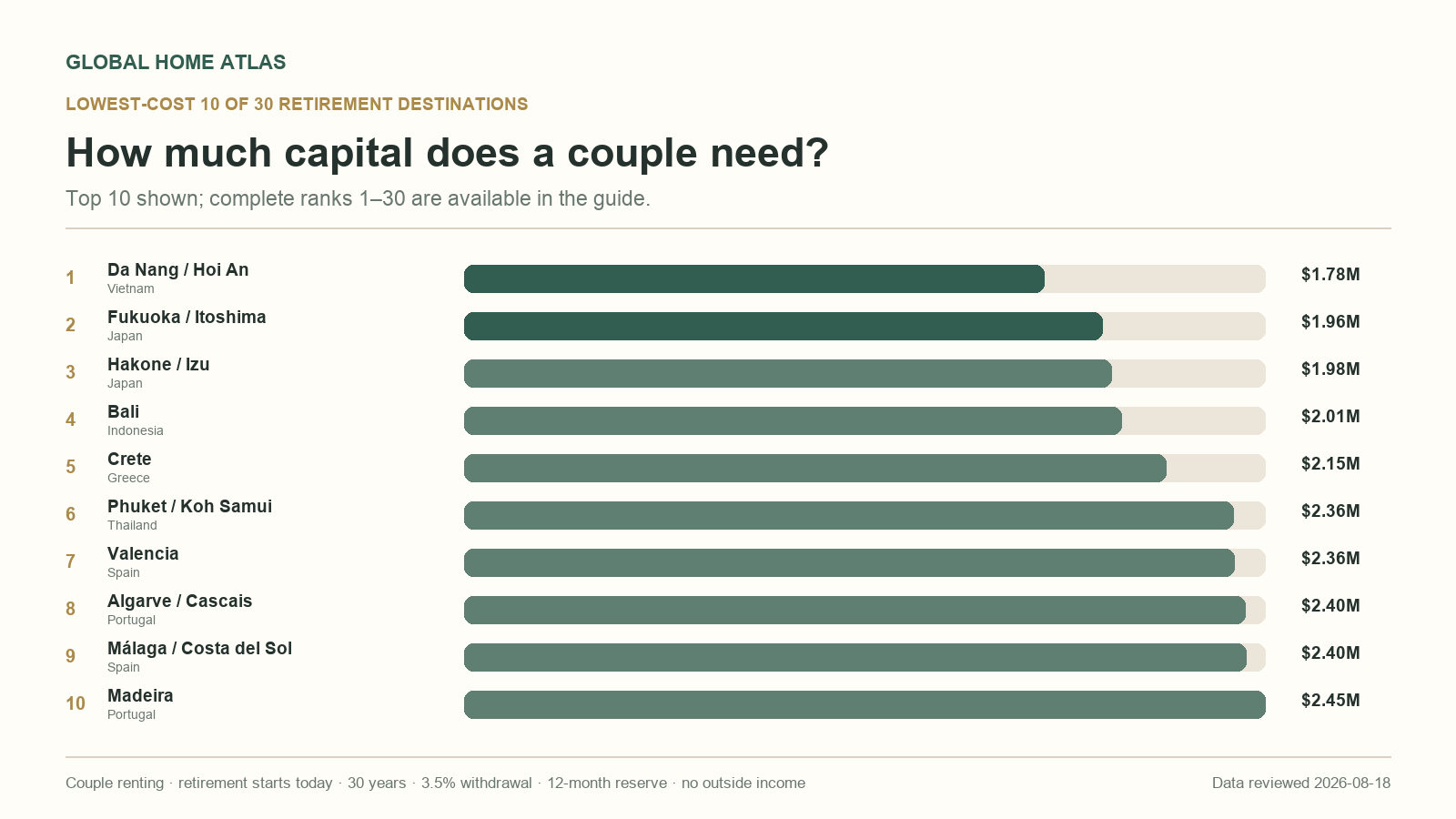
Retirement destinations ranked by savings needed
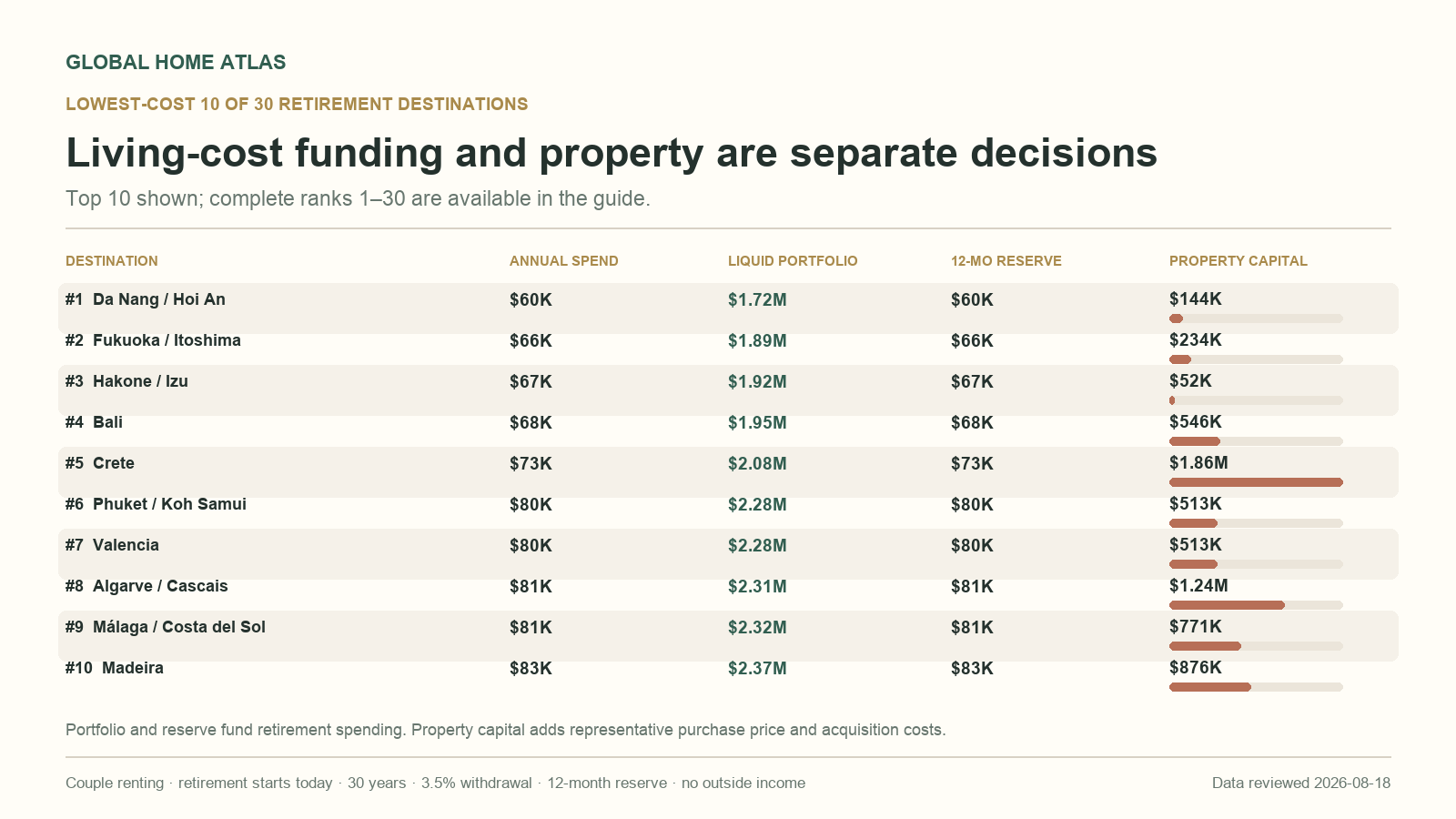
Each row uses today's USD and the same assumptions. The home purchase estimate is optional and does not affect the cost rank. Select a column heading to reorder all 33 destinations.
How annual cost is estimated
Annual cost includes rent, food and household spending, utilities and communications, private healthcare, transport, dining and leisure, travel, visa and administration costs, and contingency. Home purchase costs are separate.
| 1 | 2 | Dubai United Arab Emirates |
$58,300 | $1,724,014 | $531,700 |
|---|---|---|---|---|---|
| 2 | 30 | Da Nang / Hoi An Vietnam |
$60,100 | $1,777,243 | $141,426 |
| 3 | 1 | Fukuoka / Itoshima Japan |
$66,200 | $1,957,629 | $233,669 |
| 4 | 7 | Hakone / Izu Japan |
$67,100 | $1,984,243 | $52,224 |
| 5 | 25 | Bali Indonesia |
$68,100 | $2,013,814 | $545,669 |
| 6 | 13 | Crete Greece |
$72,800 | $2,152,800 | $1,856,058 |
| 7 | 23 | Phuket / Koh Samui Thailand |
$79,700 | $2,356,843 | $435,971 |
| 8 | 3 | Valencia Spain |
$79,800 | $2,359,800 | $512,947 |
| 9 | 4 | Algarve / Cascais Portugal |
$81,000 | $2,395,286 | $1,238,635 |
| 10 | 5 | Málaga / Costa del Sol Spain |
$81,100 | $2,398,243 | $771,348 |
View 23 more destinations
| 11 | 8 | Madeira Portugal |
$83,000 | $2,454,429 | $875,802 |
|---|---|---|---|---|---|
| 12 | 18 | Queenstown New Zealand |
$87,400 | $2,584,543 | $1,070,996 |
| 13 | 6 | Lake Como Italy |
$89,100 | $2,634,814 | $668,502 |
| 14 | 11 | Costa Brava / Girona Spain |
$93,300 | $2,759,014 | $2,018,362 |
| 15 | 17 | Croatia / Istria-Dalmatia Croatia |
$95,800 | $2,832,943 | $599,746 |
| 16 | 36 | Vancouver Island / Victoria Canada |
$107,000 | $3,164,143 | $763,453 |
| 17 | 16 | Mallorca Spain |
$109,900 | $3,249,900 | $3,450,989 |
| 18 | 22 | Perth / Margaret River Australia |
$110,200 | $3,258,771 | $1,173,802 |
| 19 | 10 | Hakuba Japan |
$118,100 | $3,492,386 | $1,673,848 |
| 20 | 15 | Annecy France |
$128,800 | $3,808,800 | $962,900 |
| 21 | 12 | Park City / Deer Valley United States |
$128,800 | $3,808,800 | $4,368,000 |
| 22 | 28 | Innsbruck / Tyrol Austria |
$128,800 | $3,808,800 | $833,976 |
| 23 | 20 | Lake Tahoe United States |
$132,200 | $3,909,343 | $2,499,000 |
| 24 | 26 | Whistler Canada |
$137,500 | $4,066,071 | $1,423,597 |
| 25 | 34 | Ticino / Lake Lugano Switzerland |
$140,400 | $4,151,829 | $1,790,123 |
| 26 | 29 | Jackson Hole United States |
$148,400 | $4,388,400 | $1,404,000 |
| 27 | 9 | Miami / Fort Lauderdale United States |
$156,200 | $4,619,057 | $865,980 |
| 28 | 14 | Niseko Japan |
$159,900 | $4,728,471 | $602,585 |
| 29 | 21 | Dolomites / South Tyrol Italy |
$159,900 | $4,728,471 | $768,777 |
| 30 | 24 | Chamonix France |
$162,200 | $4,796,486 | $1,928,371 |
| 31 | 31 | Aspen / Snowmass United States |
$162,200 | $4,796,486 | $2,875,000 |
| 32 | 27 | Andermatt Switzerland |
$167,800 | $4,962,086 | $3,964,446 |
| 33 | 35 | Swiss Valais / Vaud Alps Switzerland |
$170,200 | $5,033,057 | $3,027,656 |
Why the capital figures differ
Required liquid portfolio capital magnifies differences in annual spending: at a 3.5% withdrawal rate, every additional $10,000 of first-year spending adds about $285,700 to the modeled portfolio. The emergency reserve then adds another year of expenses.
Property capital tells a different story. It combines the representative purchase price with estimated acquisition costs and can be much higher—or much lower—than the cost rank suggests. It is shown separately because buying is optional and listing samples are not market-wide medians.
What to know about the top 10
The cost rank is a starting point, not a recommendation. Visa eligibility, taxes, healthcare access, language, neighborhood choice, climate, ownership rules, and resale depth require separate review.
-
1
Dubai United Arab Emirates
$1,724,014A clear designated-freehold market with exceptional connectivity and resident demand. Prefer completed, documented buildings with defensible service charges over promotional off-plan stories.
-
2
Da Nang / Hoi An Vietnam
$1,777,243Da Nang combines a real coastal city, useful regional access and accessible apartment entry points. The controlling risks are project-specific foreign eligibility, time-limited ownership, lawful use, flood exposure and a narrower eligible resale pool.
-
3
Fukuoka / Itoshima Japan
$1,957,629The panel would treat this as the most practical “use it, rent it, live in it” candidate: not the most dramatic scenery, but the combination of airport access, food, safety, healthcare and clean ownership is unusually strong.
-
4
Hakone / Izu Japan
$1,984,243This is the Tokyo-adjacent lifestyle option: easier to use often, cleaner to own, and more resilient domestically than many pure tourism plays. The panel would like it for optionality but question international demand depth.
-
5
Bali Indonesia
$2,013,814Bali is a compelling lifestyle and hospitality market, but the legal interest, remaining lease term and permitted operation control the investment. Treat it as a specialist operating proposition, not simple foreign freehold.
-
6
Crete Greece
$2,152,800Crete is attractive because it combines affordability, food, beaches, history and a real local population. The panel would like the value angle but question liquidity and seasonality outside the best towns.
-
7
Phuket / Koh Samui Thailand
$2,356,843Phuket and Koh Samui can deliver exceptional tropical daily life, but the legal product comes first: foreign-quota condominium, leasehold, building ownership and land rights have different risk and resale profiles.
-
8
Valencia Spain
$2,359,800This is one of the cleanest European retirement/liveability candidates. It wins on food, healthcare, cost, culture and year-round demand, but it is more lifestyle city than trophy holiday resort.
-
9
Algarve / Cascais Portugal
$2,395,286A proven retirement and second-home market with clean ownership and strong lifestyle appeal. The panel would like the risk-adjusted case, but would separate Cascais from Algarve in deeper diligence because economics and liquidity differ.
-
10
Málaga / Costa del Sol Spain
$2,398,243This is a high-conviction lifestyle/retirement market because it has airport scale, healthcare, beach, food and a large expat ecosystem. The issue is whether you are buying after too much price appreciation.
Destinations, not countries
Country averages hide the decision retirees actually make. Valencia and Málaga share Spain's national framework, while Fukuoka / Itoshima and Hakone / Izu share Japan's, but housing, transport, access, and daily routines differ locally. We therefore rank destinations and keep the country visible as legal, tax, visa, and healthcare context.
The ranking does not rank lifestyle quality. A higher-cost destination may be the better personal fit, and a lower-cost destination can carry trade-offs that matter more than the savings.
Methodology and assumptions
The ranking models a couple renting, with retirement starting today. It is designed for comparison rather than personal advice.
- 30-year retirement horizon.
- 3.5% withdrawal rate.
- 12 months of expenses held as an emergency reserve.
- No pension or other passive income.
- Comfortable, not luxury, destination budgets in today's USD.
- Liquid portfolio equals annual spending divided by 3.5%.
- Required retirement capital equals liquid portfolio plus the reserve.
- Property capital equals representative purchase price plus acquisition costs and is excluded from rank.
Portfolio dividends and interest are already part of the portfolio withdrawal and must not be subtracted again as passive income. Reliable after-tax pension, annuity, business, or net rental income can reduce your personal funding gap in the calculator.
See the full research methodology. Data reviewed 2026-08-18.
Sources and data notes
- Numbeo — Dubai cost of living — Current rent, utilities, transport, food and local cost observations (31 August 2026)
- Numbeo — Da Nang cost of living — Rent, groceries, utilities, transport and dining benchmarks (2026)
- Numbeo — Fukuoka cost of living — Rent, utilities, transport, dining and local cost benchmarks (May 2026)
- Numbeo — Japan cost of living — National cost and rent proxy for Hakone / Izu (June 2026)
- Numbeo — Bali cost of living — Rent, groceries, utilities, transport and dining benchmarks (2026)
- Numbeo — Heraklion cost of living — Crete urban rent and local cost proxy (May 2026)
- Numbeo — Phuket cost of living — Rent, groceries, utilities, transport and dining benchmarks (2026)
- Numbeo — Valencia cost of living — Rent, groceries, utilities, transport and dining benchmarks (July 2026)
- Numbeo — Algarve cost of living — Algarve rent and local cost benchmarks (June 2026)
- Numbeo — Málaga cost of living — Rent, groceries, utilities, transport and dining benchmarks (May 2026)
- Numbeo — Funchal cost of living — Rent, groceries, utilities, transport and dining benchmarks (May 2026)
- Numbeo — Queenstown New Zealand cost of living — Rent, groceries, utilities, transport and dining benchmarks (2026)
- Numbeo — Como cost of living — Rent, groceries, utilities, transport and dining benchmarks (June 2026)
- Numbeo — Girona cost of living — Rent, groceries, utilities, transport and dining benchmarks (2026)
- Numbeo — Split cost of living — Rent, groceries, utilities, transport and dining benchmarks (2026)
- Numbeo — Victoria cost of living — Rent, groceries, utilities, transport and dining benchmarks (2026)
- Numbeo — Palma De Mallorca cost of living — Rent, groceries, utilities, transport and dining benchmarks (2026)
- Numbeo — Perth cost of living — Rent, groceries, utilities, transport and dining planning benchmarks (2026)
- Numbeo — Nagano Japan cost of living — Rent, groceries, utilities, transport and dining benchmarks (2026)
- Numbeo — Annecy France cost of living — Rent, groceries, utilities, transport and dining benchmarks (2026)
- Numbeo — Salt Lake City cost of living — Rent, groceries, utilities, transport and dining benchmarks (2026)
- Numbeo — Innsbruck cost of living — Rent, groceries, utilities, transport and dining benchmarks (2026)
- Numbeo — Reno cost of living — Rent, groceries, utilities, transport and dining benchmarks (2026)
- Numbeo — Vancouver cost of living — Rent, groceries, utilities, transport and dining benchmarks (2026)
- Numbeo — Lugano cost of living — Rent, groceries, utilities, transport and dining benchmarks (2026)
- Numbeo — Jackson WY United States cost of living — Rent, groceries, utilities, transport and dining benchmarks (2026)
- U.S. Bureau of Labor Statistics — CPI — General inflation planning assumption (2026)
- Numbeo — Sapporo cost of living — Rent, groceries, utilities, transport and dining benchmarks (2026)
- Numbeo — Bolzano Bozen Italy cost of living — Rent, groceries, utilities, transport and dining benchmarks (2026)
- Numbeo — Chamonix France cost of living — Rent, groceries, utilities, transport and dining benchmarks (2026)
- Numbeo — Denver cost of living — Rent, groceries, utilities, transport and dining benchmarks (2026)
- Numbeo — Lucerne cost of living — Rent, groceries, utilities, transport and dining benchmarks (2026)
- Numbeo — Lausanne cost of living — Rent, groceries, utilities, transport and dining benchmarks (2026)
Use the ranking without over-reading it
Start with the cost range, then test a personal scenario. Change household spending, retirement date, pension and passive income, housing plan, inflation, and planning horizon before comparing property. A financially viable location can still fail on residency, tax, healthcare, or day-to-day fit.
Continue with the retirement property destination guide, then open destination dossiers and consult qualified local legal, tax, immigration, healthcare, and financial advisers before acting.
Frequently asked questions
What is the lowest-cost retirement destination in this comparison?
Da Nang / Hoi An has the lowest required retirement capital under this article's standard couple-renting scenario. The comparison covers all 33 destinations currently covered by Global Home Atlas, not every place retirees could choose.
Why rank retirement destinations instead of countries?
Housing, transport, healthcare access, and daily costs vary widely inside one country. Destination-level comparisons are more useful for planning, while the country remains visible for legal, tax, visa, and healthcare context.
Does the ranking include pension or passive income?
No. The common ranking scenario assumes no pension or other passive income so every destination is comparable. The retirement calculator lets readers add reliable after-tax income separately.
Is property included in the retirement cost ranking?
No. The ranking assumes renting. Representative property price plus acquisition costs is shown separately because buying decisions can dominate the comparison and depend heavily on property type and micro-location.