Start here
Buying property does not give you residency
A Greek deed creates no visa, residence permit or public-healthcare entitlement. EU and EEA citizens can use the economically inactive residence route when they have sufficient resources and comprehensive health cover. A non-EU retiree normally needs a separate permit before treating a Cretan home as a permanent base.
The financially independent person route is renewable and currently requires at least €2,000 per month, increased for a spouse and children, together with private insurance; it does not authorise employment. Greece's property-investment permit is a different route. In Crete the ordinary current real-estate threshold is €800,000, with separate conversion and restoration routes subject to their own rules. See the official financially independent permit requirements and the current investment thresholds.
Decision rule: establish the residence route, renewal conditions and healthcare plan before reserving a property.
Who Greece suits
Greece is a strong fit for retirees who can qualify independently for residence, value outdoor life and community over frictionless administration, and can choose a Cretan location for year-round services rather than summer atmosphere alone.
Look elsewhere first if the purchase must itself create residence, year-round car-free life is essential outside a city, rental income must fund the plan, or heat, wildfire, water and seismic diligence feel disproportionate to the lifestyle benefit.
What changed in 2025–2026
From 1 October 2025, short-term rental homes must meet national minimum conditions covering primary use, natural light and ventilation, liability insurance, electrical certification and safety equipment. Registration with AADE remains only one layer; planning, building, condominium and any local restrictions still apply.
The individual rental-income schedule for 2026 uses 15%, 25%, 35% and 45% bands. Capital-gains tax on property transfers remains suspended through 31 December 2026. These dates are planning inputs, not reasons to accelerate a weak purchase.
Financing and ownership costs
Obtain an AFM tax number before acquisition. Transfer tax is 3% plus the municipal surcharge—an effective 3.09%—on the taxable value, before notary, registry, lawyer, engineer, agent, survey, insurance and renovation costs. New-build VAT treatment and exemptions require transaction-specific advice.
Owners file E9 property data and may owe annual ENFIA. Nonresident financing is limited and evidence-heavy, so model a cash purchase unless a lender has issued written terms. Budget for cooling, water storage, vehicle dependence and maintenance during long absences, not only the closing statement.
Decision rule: compare five-year cash outlay after tax, insurance, utilities, repairs and local management—not the asking price alone.
Retirement practicality beyond the purchase
Healthcare follows residence and location. EU pensioners may be able to register an S1; other residents need the coverage attached to their status. Chania and Heraklion offer the island's deepest hospital access. Remote villages and eastern or southern coastlines require a realistic transfer plan.
Legal buildability must be proved. Match title and cadastral data, building permits, floor area, boundaries, forest-map status, shoreline and archaeological constraints, planning compliance, shared access and utilities. An attractive rural house can be hard to regularise, insure or resell.
Climate risk is address-specific. Review wildfire exposure and evacuation, seismic condition, slope and flash-flood drainage, summer water reliability, shade and cooling. Visit during the hottest and wettest periods before deciding that a holiday rhythm is a retirement rhythm.
Greece through five retirement lenses
Crete rewards buyers who choose a functioning year-round base first and a view second. These five lenses connect legal residence, daily life, building condition and exit quality.
Secure residence and healthcare first
The deed cannot repair an unsuitable permit. Match the household to EU residence, financially independent status or another lawful route, then confirm insurance, renewal evidence and hospital access before choosing a village.
Choose the daily-life catchment
Chania and nearby Apokoronas offer different compromises: the city for walkability and services; the villages for space and a more car-dependent routine. Heraklion adds the island's strongest administrative and medical depth, while eastern Crete is quieter and more seasonal.
Make the house work in August and January
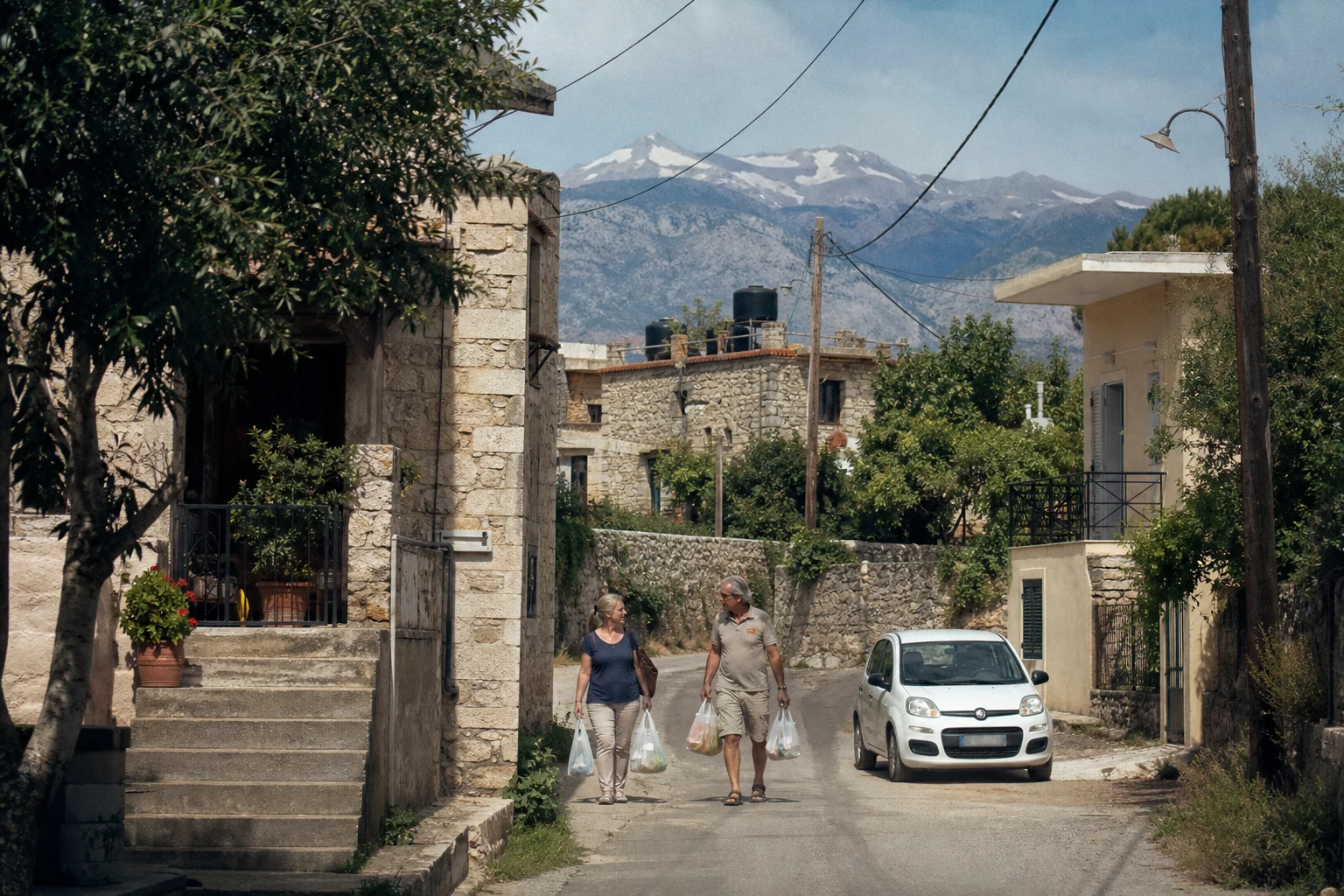
Shade, cross-ventilation, efficient cooling, heating, damp control, water storage and all-weather access matter more than decorative finish. Test the road to groceries, hospital and airport in peak heat and winter rain.
Prove the building and its legal use
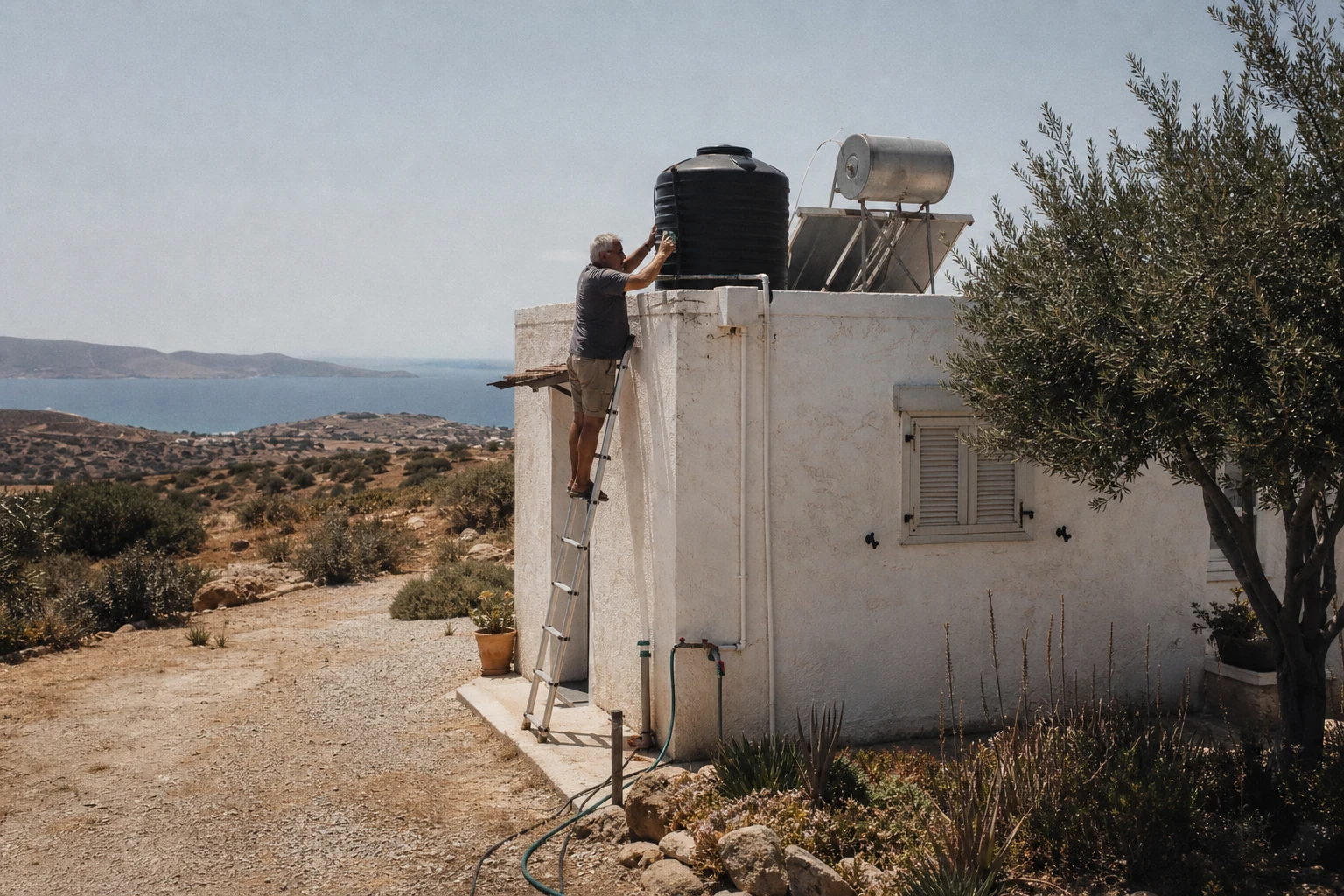
Reconcile title, cadastral record, permits, engineering condition, access and utility rights. If visitor letting matters, verify the 2025 minimum standards plus registration, planning and any building restrictions for the exact address.
Protect the exit
Prefer documented, insurable homes near ordinary services with a broad domestic and international buyer pool. A singular remote villa may be wonderful to occupy yet slower and more expensive to resell.
Estimate your retirement capital
Start with destination expenses in today's money, then account for inflation, reliable pension and passive income, housing, property acquisition, and a liquid portfolio.
Open the retirement abroad calculatorCrete is not one retirement market
Chania and Apokoronas, Heraklion, and the quieter eastern and southern districts create different trade-offs even though they share national law.
| Destination | Best for | Daily-life read | Primary diligence | Rental stance |
|---|---|---|---|---|
| Crete | A year-round island life anchored to Chania or Heraklion services | City and near-city locations are easier; rural and eastern bases need more driving and contingency | Residence, title, permits, forest and shoreline status, seismic condition, water, wildfire and access | AADE registration, 2025 minimum standards, planning and building rules all apply |
Related Buying Guides
Use these adjacent guides to test the same shortlist from a different buyer intent before committing to local diligence.
Crete property for retirement: areas, costs and buyer guide
Compare Crete retirement property across Chania, Rethymno, Heraklion and eastern Crete, with buyer rules, costs, healthcare, hazards and resale.
Best Places to Buy Property Abroad for Retirement
Compare the best places to buy property abroad for retirement using ownership clarity, healthcare, lifestyle, value, rental resilience, and exit liquidity.
Buying Property Abroad for Retirement
A retirement-focused framework for buying property abroad, comparing ownership clarity, healthcare practicality, lifestyle fit, value, and resale flexibility.
Greece vs Portugal Retirement Property
Compare Greece and Portugal retirement property options for foreign buyers focused on lifestyle, value, ownership, rentals, and long-term livability.
FAQ
Does buying property give a foreigner residency in Greece?
No. Ownership and residence are separate, although Greece has immigration routes with their own investment or financially independent person conditions.
Can foreigners buy property in Greece?
Foreign buyers can generally acquire Greek property, subject to nationality, border-area restrictions, title, planning, forestry, archaeology, tax and building-specific review.
How does healthcare work for foreign retirees in Greece?
Healthcare access depends on lawful residence, social-security or coordination rights, and insurance—not on owning a home.
Is Crete practical for year-round retirement?
Crete can work when the home has reliable access to a functioning town, healthcare, flights and services through winter; remote and highly seasonal locations require more resilience.
References and update policy
Residence, tax, building and short-let rules come from separate authorities. Recheck the permit route and the exact Cretan property with Greek legal, tax and engineering advisers before signing. This guide was substantively reviewed on 27 August 2026.
- EU: residence for economically inactive citizens
- Attica administration: financially independent permit
- Greek government: property-investment thresholds
- AADE: steps before buying
- AADE: real-estate transfer tax
- AADE: E9 and ENFIA
- Finance Ministry: 2026 rental-income bands and property-gain suspension
- AADE: nonresident property-tax FAQs
- Tourism Ministry: 2025 short-let standards
- AADE: short-term rentals
- Greek Cadastre: forest maps
- Civil Protection: forest-fire guidance